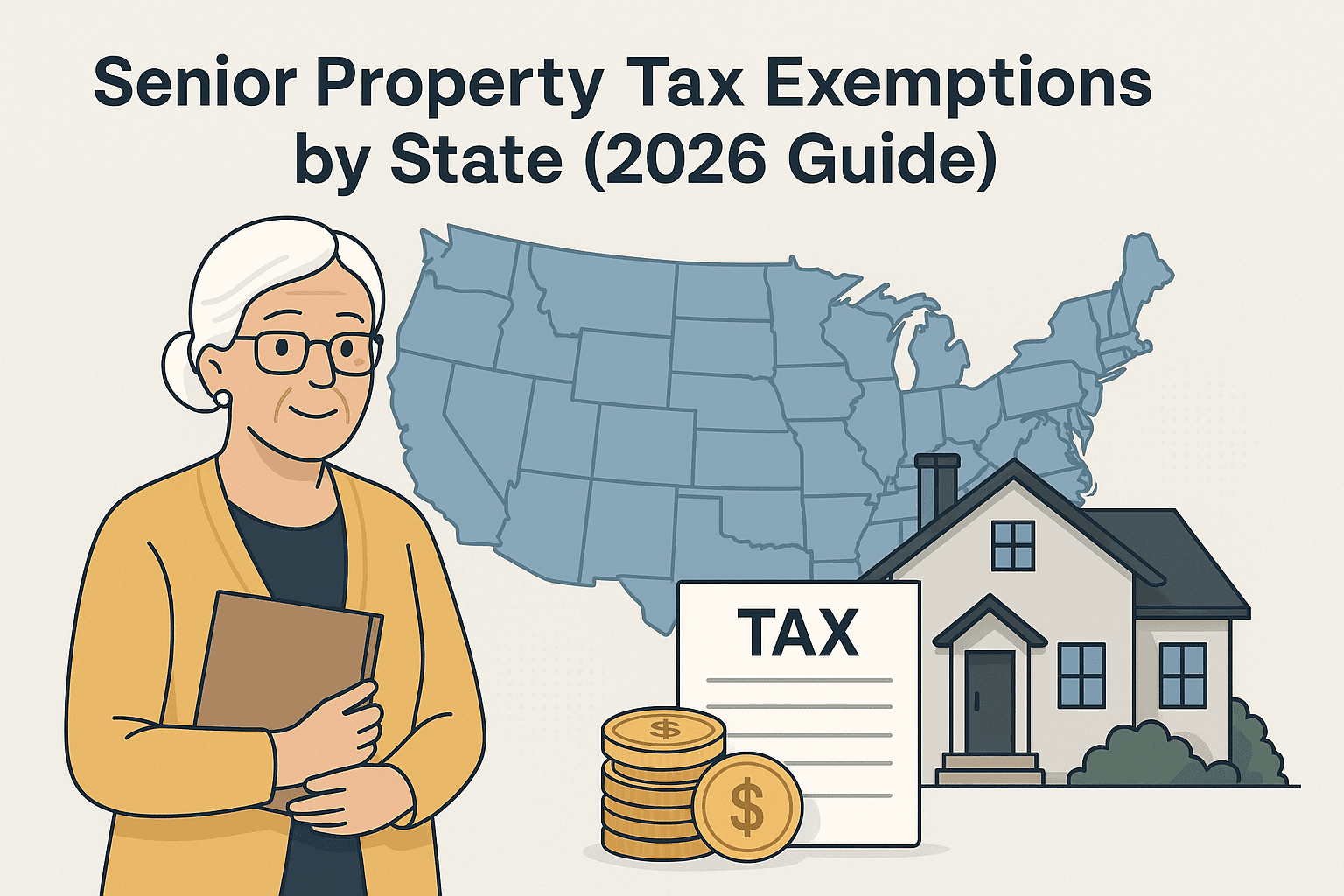
If you are 65 or older and own your home, you may be leaving real money on the table. Here is how the major types of senior property tax relief work and which states are known for the most generous programs.
The 4 main types of senior property tax relief
1. Homestead exemptions
The most common form. A portion of your home''s assessed value is excluded from taxation, lowering your bill. Many states offer an extra senior add-on on top of the standard homestead exemption. Amounts and age/income rules vary widely by state and county.
2. Property tax freezes
Lock in your home''s assessed value (or the tax amount itself) at a set year so your bill does not rise as values climb. Texas, Oklahoma, and several others offer freeze programs for qualifying seniors — extremely valuable in fast-appreciating areas.
3. Tax deferrals
Let you postpone paying some or all property taxes until you sell the home or pass away, at which point the deferred amount (often plus modest interest) is repaid from the estate. Useful for house-rich, cash-poor seniors who want to stay in place.
4. Circuit-breaker credits
Income-based relief that "kicks in" when property taxes exceed a set percentage of income, refunding the excess. These target lower- and middle-income seniors regardless of home value.
States known for strong senior property tax relief
- Texas — generous senior homestead exemption plus a school-tax freeze at 65; no state income tax.
- Florida — additional homestead exemptions for seniors (county-dependent) plus the Save Our Homes assessment cap.
- South Carolina — Homestead Exemption excludes a sizable chunk of value for residents 65+.
- Georgia — multiple senior exemptions, some eliminating school taxes entirely for qualifying ages/incomes.
- New York — Enhanced STAR plus the Senior Citizens Homeowners'' Exemption (SCHE) for income-eligible seniors.
- Illinois — Senior Citizens Homestead Exemption and a separate Assessment Freeze for income-eligible owners.
- New Jersey — Senior Freeze (property tax reimbursement) refunds increases above your base year for eligible seniors.
This list is illustrative, not exhaustive — programs change yearly and most are administered at the county or local level.
How to claim your exemption
- Confirm eligibility. Check the age (usually 65+), residency, ownership, and any income limits for your state and county.
- Find the right office. Apply through your county assessor, tax collector, or department of revenue — not the state in most cases.
- Gather documents. Typically proof of age, proof the home is your primary residence, and income documentation if required.
- Apply by the deadline. Many exemptions have strict annual filing windows; some require a one-time application, others require yearly renewal.
- Stack where allowed. You can often combine a base homestead exemption with a senior add-on and a freeze.
Common mistakes that cost seniors money
- Assuming it is automatic. The vast majority of programs require you to apply — they are not applied by default.
- Missing income deadlines or thresholds. Being a dollar over a limit, or filing late, can disqualify you for the year.
- Not reapplying. Some programs need annual renewal; lapses reset your benefit.
- Overlooking freezes in rising markets. A freeze can be worth far more than a flat exemption where home values are climbing fast.
Bottom line
Senior property tax relief exists in most states in 2026, but it rarely arrives on its own — you have to apply, meet the age and income rules, and hit the deadline. Start by calling your county assessor''s office to ask exactly which senior exemptions, freezes, deferrals, or credits you qualify for, and stack every benefit you are allowed.
This article is for general educational purposes only and is not tax or legal advice. Property tax programs, amounts, eligibility, and deadlines vary by state, county, and year — confirm details with your local tax authority or a qualified tax professional.