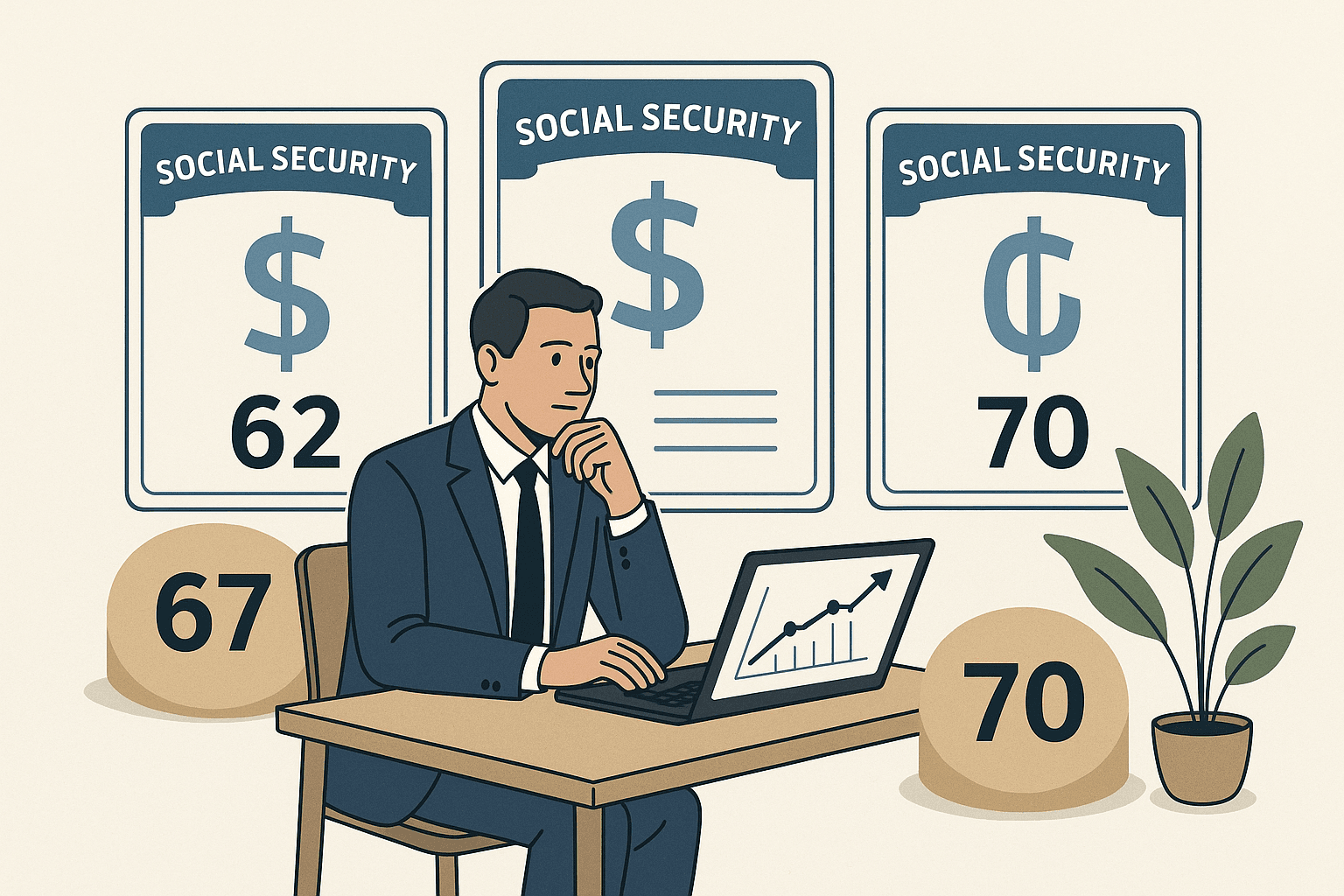
Choosing when to claim Social Security can mean more than $100,000 in lifetime benefit differences depending on your health, income, and marital status. Claiming at 62 vs. waiting until 70 creates a monthly benefit difference of 76% — but the "right" answer is different for every person. We modeled 8 real claiming scenarios with breakeven ages, spousal coordination strategies, and the hidden factors most guides don't cover, so you can make this irreversible decision with full information.
This guide is for educational purposes only and does not constitute financial advice. Social Security rules are complex and change periodically. Consult a licensed financial advisor or Social Security Administration representative before making claiming decisions.
How We Evaluated These Scenarios
| Factor |
Why It Matters |
| Breakeven Age |
When delayed claiming recoups foregone early benefits |
| Health and Life Expectancy |
Fundamentally determines which strategy wins financially |
| Spouse Benefit Coordination |
Married strategies differ significantly from single |
| Other Income Sources |
Affects whether you need benefits early or can afford to wait |
Data sources: Social Security Administration benefit calculators, SSA 2026 benefit tables, Center for Retirement Research at Boston College claiming strategy research.
Scenario 1: Healthy Single Filer, Age 62 Decision Point — Wait if You Can
Profile: Single, good health, modest retirement savings, age 62
Full Retirement Age (FRA) benefit: $2,000/month (example)
Age 62 benefit: $1,400/month (30% reduction)
Age 70 benefit: $2,480/month (24% increase)
Claiming at 62 vs. 70 creates a $1,080/month ($12,960/year) difference at the same earnings record. The breakeven age — where total lifetime benefits equalize — is approximately 80 years old. If you live past 80, waiting to 70 wins financially. Current Social Security Administration data shows the average 62-year-old woman will live to 86.6; the average man to 84.3.
Who Should Claim at 62
- Terminal or serious illness diagnosis with life expectancy under 78
- Forced retirement with no other income and depleted savings
- Divorced spouse claiming against ex-spouse's record while protecting own benefit for later
Who Should Wait
- Good to excellent health with family history of longevity
- Still working (earned income reduces benefits before FRA)
- Can fund living expenses from other sources until 67–70
Scenario 2: Married Couple with Earning Disparity — Survivor Benefit Strategy
Profile: Husband (higher earner, $3,000 FRA benefit); Wife (lower earner, $1,200 FRA benefit)
Strategic goal: Maximize survivor benefit for the likely-surviving spouse
The highest-earning spouse's benefit becomes the survivor benefit when one spouse dies. If the high earner claims at 62 ($2,100/month) vs. waiting to 70 ($3,720/month), the surviving spouse's income in widowhood differs by $1,620/month — a potentially 10–20+ year income difference.
The optimal strategy for most couples with earnings disparity: lower earner claims early; higher earner waits to 70. This provides income during the waiting period while maximizing the permanent survivor benefit.
Key numbers
- Every year the high earner waits past FRA: +8% permanently
- Survivor receives the higher of their own or their spouse's benefit — not both
- If both spouses earned similar amounts: independent breakeven analysis for each
Who This Benefits Most
Couples where one spouse earned significantly more over their career, and where the higher earner is expected to have the shorter life expectancy (often men). This survivor-optimized strategy can add $200,000+ in lifetime household benefits compared to both claiming at 62.
Scenario 3: Early Retirement with Adequate Savings — Classic Delay Strategy
Profile: Age 62, retired with $800K in savings, healthy
Monthly expenses: $4,500/month
FRA benefit: $2,800/month
This profile — adequate savings, healthy, early retirement by choice — is the clearest case for waiting to 70. Drawing down savings from 62–70 to fund living expenses, then claiming $3,472/month at 70 (vs. $1,960/month at 62), effectively converts portfolio assets into guaranteed lifetime income at a favorable "return." The 8% annual increase from FRA to 70 is a risk-free government-backed return unavailable in any market instrument.
The math
- Delay cost: ~$235,000 in foregone benefits from 62–70
- Recovery: Additional $18,144/year in benefits at 70
- Breakeven: ~13 years post-70 (age 83)
- Expected lifetime gain: $100,000–$300,000+ for those living into late 80s
Who This Benefits Most
Early retirees with sufficient assets to fund living expenses independently until 70. The portfolio drawdown during the delay period is essentially an investment in a higher guaranteed annuity.
Scenario 4: The "62 and Working" Trap — Most Costly Mistake
Profile: Age 63, still employed full-time, claims early
Annual earnings: $65,000
FRA benefit: $2,200/month
Claiming Social Security before FRA while earning above the earnings limit ($22,320 in 2026) triggers the earnings test — SSA withholds $1 for every $2 earned above the limit. At $65,000 in earnings, the withheld benefits would be approximately $1,059/month in the example above — effectively eliminating the "early" benefit entirely.
The withheld benefits are not lost permanently (they're added back as credit at FRA), but the administrative complexity and tax implications make early claiming while working a costly mistake most people discover after the fact.
The rule
If you're under FRA and earning more than $22,320/year, do not claim early. The earnings test penalty eliminates most of the early claiming benefit while permanently reducing your base benefit rate.
Scenario 5: Divorced Spouse Strategy — Hidden 50% Benefit
Profile: Divorced, married 10+ years, ex-spouse's FRA benefit $3,600/month
Own FRA benefit: $900/month
Divorced spouses who were married for 10+ years can claim up to 50% of an ex-spouse's FRA benefit — regardless of remarriage status of the ex. At $3,600 FRA benefit, the divorced spouse can claim $1,800/month — vs. $900/month on their own record. Critically, this claiming does not affect the ex-spouse's benefit in any way.
Optimal divorced spouse strategy: claim against the ex's record early to maximize total lifetime benefits, while protecting your own record to grow until 70 if your own benefit ultimately exceeds 50% of the ex's FRA.
Eligibility requirements
- Married at least 10 years
- Currently unmarried (remarriage disqualifies you from ex-spouse benefits while remarried)
- Ex-spouse must be at least 62 (they do not need to have claimed)
Scenario 6: Health Crisis at 63 — When Claiming Early is the Right Call
Profile: Age 63, recent serious health diagnosis, reduced life expectancy to ~75
FRA benefit: $2,400/month
Breakeven analysis shifts entirely with reduced life expectancy. For a 63-year-old with expected longevity to age 75: claiming at 63 produces ~$244,800 in total lifetime benefits (roughly). Waiting to 67 (FRA) produces ~$230,400. Waiting until 70 produces only ~$178,560.
When life expectancy is meaningfully below 80, early claiming is the financially optimal strategy. A trusted financial advisor or the SSA's own benefit calculator can model your specific scenario with actual benefit amounts.
Quality of life consideration
Beyond pure math, early claiming provides income during a period when health-related expenses are increasing. This non-mathematical factor often makes early claiming the right call even at borderline breakeven ages.
Scenario 7: The "File and Suspend" Era Is Over — What Replaced It
Profile: Couples planning around pre-2016 strategies
The "file and suspend" strategy — where one spouse claimed to trigger spousal benefits while suspending their own benefit to grow — was eliminated in 2016. Many older guides still reference it. In 2026, the primary coordinated claiming strategies available are:
- Restricted application (for those born before January 2, 1954 only — largely aged out by 2026)
- Delayed claiming for higher earner paired with early claiming for lower earner (the current standard dual-income strategy)
- Spousal benefit coordination at FRA if your own benefit is less than 50% of spouse's FRA benefit
Any advisor or tool recommending file-and-suspend strategies is working with outdated information.
Scenario 8: Still Working at 65–67 — Full Retirement Age Baseline
Profile: Age 65, still working full-time, planning to retire at 67
Earning above the earnings limit
For those still working at FRA (67 for those born 1960 or later), the calculus simplifies: no earnings test applies after FRA. If you reach FRA still working and don't need the income, the decision reduces to: claim now or wait up to 3 more years for 8%/year growth?
For most employed people at FRA with a longer-term health outlook: waiting to 70 still produces the best lifetime outcome, with the added benefit that you have no income need to fund during the waiting period.
Key decision factors at FRA
- Need the income now? Claim.
- In good health and don't need the income? Wait for 8%/year guaranteed growth.
- Uncertain? Split the difference by claiming at 68–69.
Social Security Claiming Age Quick Reference
| Claiming Age |
% of FRA Benefit |
Breakeven vs. 70 |
| 62 |
70% |
~80 years old |
| 63 |
75% |
~80.5 years old |
| 64 |
80% |
~81 years old |
| 65 |
86.7% |
~81.5 years old |
| 66 |
93.3% |
~82 years old |
| 67 (FRA) |
100% |
~82.5 years old |
| 68 |
108% |
~83 years old |
| 69 |
116% |
~83.5 years old |
| 70 |
124% |
— (maximum) |
Percentages based on FRA of 67 (born 1960 or later). Breakeven ages are approximate.
How We Researched This
This guide draws on Social Security Administration benefit tables and claiming rules, the Center for Retirement Research at Boston College claiming strategy research, the Social Security Open Government Data, and AARP Social Security claiming strategy guides. Benefit examples use illustrative amounts — your actual benefit depends on your earnings history. Use the SSA's my Social Security portal (ssa.gov/myaccount) for personalized estimates. Last updated: April 2026. We review this guide annually.
Frequently Asked Questions
At what age should I claim Social Security?
There is no single right answer. The financially optimal claiming age depends on your health, life expectancy, marital status, and need for income. As a general rule: if you're in good health and can afford to wait, claiming at 70 maximizes lifetime benefits for single filers and survivor benefits for married couples.
What is the Social Security break-even age?
The breakeven age — where total lifetime benefits from delayed claiming surpass early claiming — is approximately 78–82 depending on your specific claiming ages being compared. For claiming at 62 vs. 70: the breakeven is approximately age 80. If you expect to live past 80, waiting to 70 wins financially.
How much more is Social Security at 70 vs. 62?
For those born in 1960 or later (FRA of 67): claiming at 62 reduces benefits to 70% of FRA; claiming at 70 increases benefits to 124% of FRA. The difference is 54 percentage points — representing approximately $1,000–$2,000+/month difference depending on your earnings record.
Can my spouse claim on my Social Security?
Yes — your spouse can claim up to 50% of your FRA benefit as a spousal benefit, regardless of their own work history, as long as you have claimed your own benefit. Spousal benefits are available at age 62 (with reduction) or full at the spouse's own FRA.
What happens to Social Security if I keep working after 62?
If you claim before your Full Retirement Age and earn above the annual earnings limit ($22,320 in 2026), SSA withholds $1 in benefits for every $2 earned above the limit. This effectively eliminates most of the early claiming benefit if you're earning above threshold. After FRA, there is no earnings limit.
Can I change my mind after claiming Social Security?
You can withdraw your application within 12 months of claiming and repay all benefits received — essentially "undoing" your claim. After 12 months, you can voluntarily suspend benefits between FRA and age 70 to earn delayed retirement credits, but you cannot receive benefits during the suspension period.
What is the Social Security survivor benefit?
When a spouse dies, the surviving spouse receives the higher of their own benefit or the deceased spouse's benefit — not both. This makes maximizing the higher earner's benefit particularly important for couples where the higher earner may die first. Survivor benefits can begin at age 60 (50 if disabled).
Will Social Security run out of money?
The Social Security Trust Fund faces a projected depletion around 2033–2035 based on current SSA trustees reports, at which point payroll taxes alone would fund approximately 75–80% of scheduled benefits. This is a political and legislative issue — Congress has historically acted to adjust benefits and funding before full depletion. Retirees in or near retirement should plan for Social Security as a core income source while staying informed about legislative developments.
Important Disclosures
Social Security rules are complex, change periodically, and depend heavily on individual circumstances including earnings history, marital history, health status, and other retirement income. The scenarios in this guide use illustrative benefit amounts — your actual benefits will differ. Use the SSA's my Social Security portal at ssa.gov/myaccount for personalized estimates. This content is educational only and does not constitute financial advice. Consult a licensed financial planner or Social Security Administration representative before making claiming decisions.