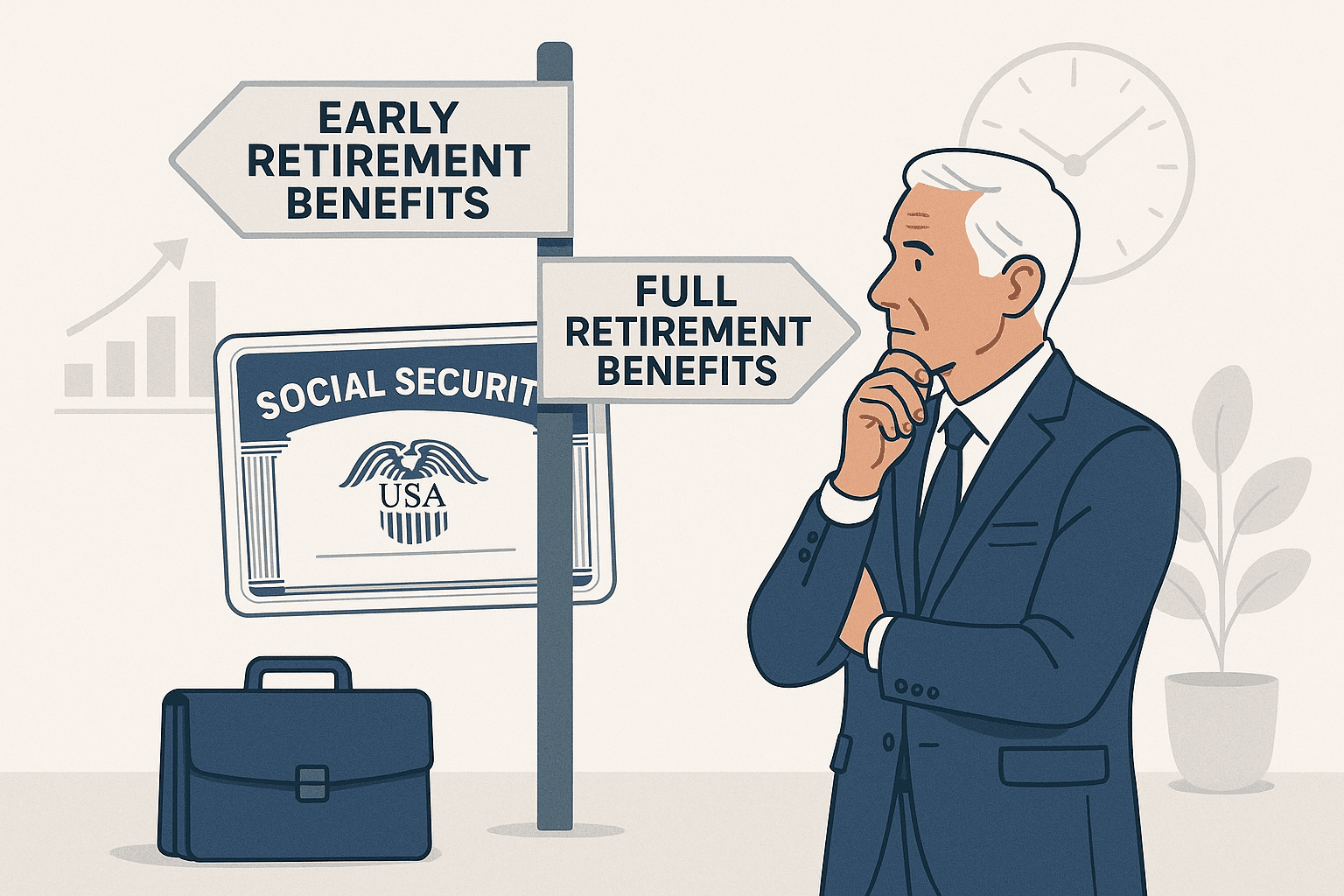
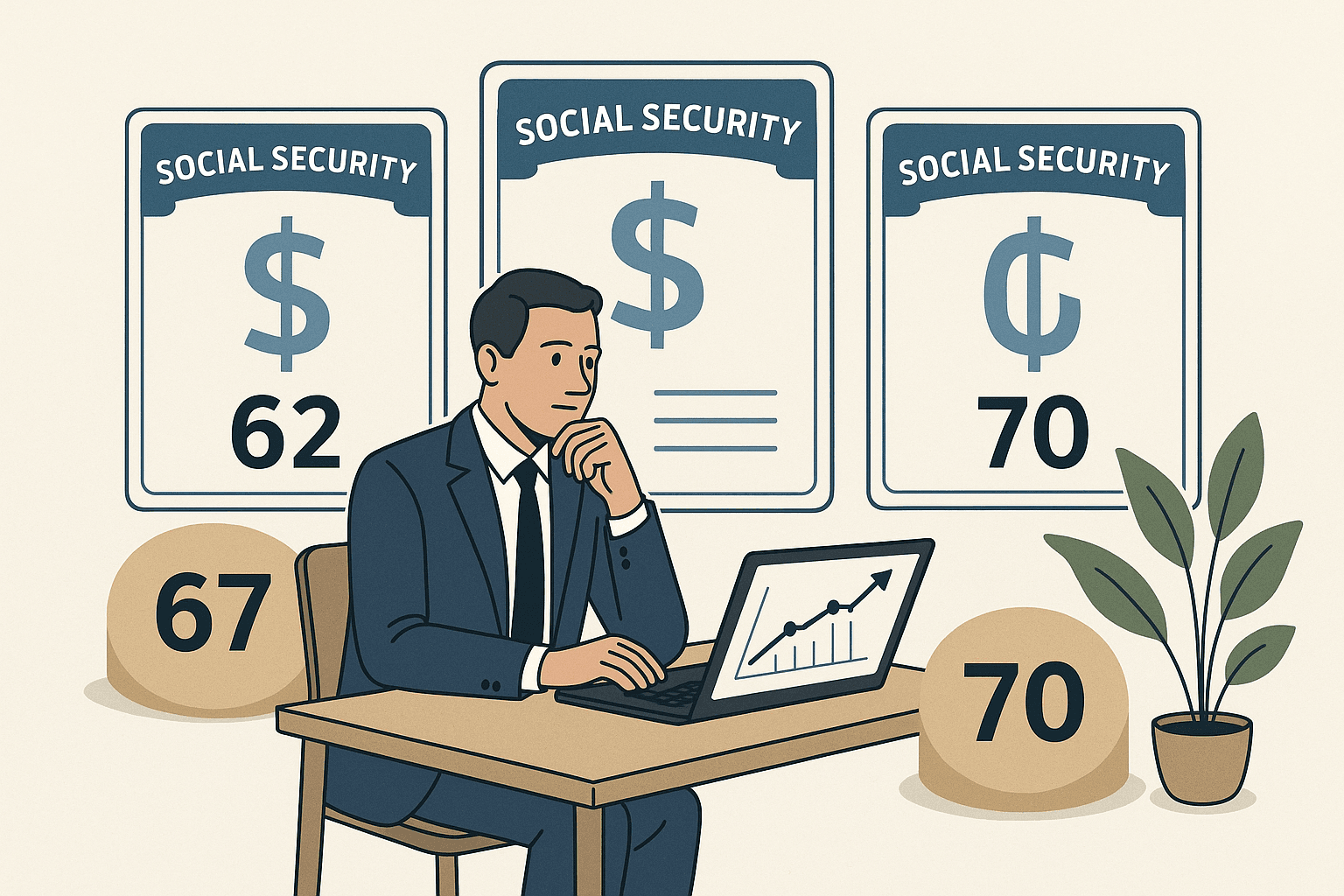
You can claim Social Security as early as age 62 or as late as age 70. Claiming early permanently reduces your monthly benefit — by up to 30% if you claim at 62. Waiting until your Full Retirement Age (FRA) gives you 100% of your earned benefit. Delaying past FRA to age 70 increases your monthly check by 8% per year. The right claiming age depends on your health, financial needs, and whether you are still working. Most people who are healthy and can afford to wait come out ahead by delaying to at least FRA.
Last updated: May 2026 | Reviewed quarterly
What Is Full Retirement Age (FRA)?
Your Full Retirement Age is the age at which you receive 100% of the Social Security benefit you have earned based on your earnings record. FRA depends on your birth year:
| Birth Year |
Full Retirement Age |
| 1943–1954 |
66 |
| 1955 |
66 and 2 months |
| 1956 |
66 and 4 months |
| 1957 |
66 and 6 months |
| 1958 |
66 and 8 months |
| 1959 |
66 and 10 months |
| 1960 or later |
67 |
Most people approaching retirement today have an FRA of 67. This is the baseline from which early claiming reductions and delayed claiming credits are calculated.
5 Key Differences Between Early and Full Retirement Benefits
1. How Much Your Benefit Is Reduced If You Claim Early
Claiming before your FRA permanently reduces your monthly benefit — and the reduction is larger the earlier you claim.
The Social Security Administration reduces benefits by:
- 5/9 of 1% per month for each month before FRA, up to 36 months
- 5/12 of 1% per month for each additional month beyond 36
What this means in dollars:
If your FRA benefit (at age 67) would be $2,000/month:
| Claiming Age |
Reduction |
Monthly Benefit |
Annual Benefit |
| Age 62 |
-30% |
$1,400 |
$16,800 |
| Age 63 |
-25% |
$1,500 |
$18,000 |
| Age 64 |
-20% |
$1,600 |
$19,200 |
| Age 65 |
-13.3% |
$1,733 |
$20,796 |
| Age 66 |
-6.7% |
$1,867 |
$22,404 |
| Age 67 (FRA) |
0% |
$2,000 |
$24,000 |
Pros of understanding this:
- Allows you to calculate the true lifetime cost of claiming early
- Helps you weigh cash flow needs vs. long-term benefit
Cons of claiming at 62:
- Permanent reduction — you cannot undo it once started
- Benefit stays reduced for life, including survivor benefits for a spouse
- If you are still working, earnings above $22,320/year (2026 limit) reduce your benefit further until you reach FRA
2. How Much Your Benefit Grows If You Delay Past FRA
Waiting past FRA earns you Delayed Retirement Credits — 8% per year, guaranteed.
This is one of the best guaranteed returns available to retirees. No investment offers a guaranteed 8% annual increase in lifetime income with no market risk.
Continuing the $2,000/month FRA benefit example:
| Claiming Age |
Increase |
Monthly Benefit |
Annual Benefit |
| Age 67 (FRA) |
0% |
$2,000 |
$24,000 |
| Age 68 |
+8% |
$2,160 |
$25,920 |
| Age 69 |
+16% |
$2,320 |
$27,840 |
| Age 70 |
+24% |
$2,480 |
$29,760 |
Delayed credits stop accruing at age 70. There is no benefit to waiting past 70.
Pros of delaying:
- Guaranteed 8%/year growth — no market risk
- Higher survivor benefit for your spouse
- More income later in life when healthcare costs often peak
- Inflation adjustments (COLA) are larger on a higher base benefit
Cons of delaying:
- Requires income from other sources (savings, spouse income, part-time work) to bridge the gap
- If you have serious health conditions, early claiming may deliver more lifetime total dollars
3. The Break-Even Calculation — When Does Waiting Pay Off?
The break-even age is when total cumulative lifetime benefits from waiting equal total benefits from claiming early.
For claiming at 62 vs. 67 (FRA), using $1,400/month vs. $2,000/month:
- At 62, you start collecting $1,400/month — 5 years of payments before FRA
- At 67, you collect $600/month more than if you had claimed at 62
- Break-even: approximately age 79–80
If you live past 80, waiting to 67 puts more total dollars in your pocket. If you do not live that long, claiming at 62 delivered more total lifetime income.
For claiming at 67 vs. 70:
- Break-even: approximately age 82–83
The practical implication: If you are in good health and your family has a history of longevity, waiting pays off for most people. The average 62-year-old American today can expect to live to approximately 83–85, which means the break-even math often favors waiting.
Pros of understanding break-even:
- Removes emotion from the decision — it becomes a math problem
- Helps couples coordinate claiming strategies
- Clarifies that this is a longevity bet, not a pure monthly income decision
4. How Early Claiming Affects Spousal and Survivor Benefits
Your claiming decision affects more than just your own check — it directly impacts your spouse.
Spousal benefits: A spouse who did not work (or earned less) can claim up to 50% of your FRA benefit. If you claim early and reduce your own benefit, the spousal benefit calculation is still based on your FRA amount — but your own reduced benefit can affect household strategy.
Survivor benefits: If you die first, your spouse can receive your full benefit amount as a survivor benefit — but only if that is higher than their own benefit. If you claimed at 62 and receive $1,400 instead of $2,000, your surviving spouse's maximum survivor benefit is $1,400, not $2,000.
The implication for couples: The higher-earning spouse should generally delay claiming as long as possible to maximize the survivor benefit. The lower-earning spouse may claim earlier to provide household income while the higher earner delays.
Example:
- Husband (higher earner): FRA benefit $2,500. Delays to 70 → $3,100/month
- Wife (lower earner): FRA benefit $1,200. Claims at 62 → $840/month + bridge income
- If husband dies first, wife receives $3,100/month survivor benefit instead of $840
This strategy can meaningfully increase lifetime household Social Security income.
5. The Working-While-Claiming Rules (Before FRA)
If you claim Social Security before FRA and are still working, your benefits may be temporarily reduced.
In 2026, if you claim before your FRA:
- You can earn up to $22,320/year without any benefit reduction
- For every $2 earned above $22,320, Social Security withholds $1 in benefits
- In the year you reach FRA, the limit increases to $59,520, and only $1 is withheld per $3 earned above that
Good news: The withheld benefits are not lost forever. After you reach FRA, the SSA recalculates your benefit upward to account for months your benefit was withheld.
Practical implication: If you are still working and earning a meaningful income, claiming before FRA usually makes little sense — the earnings test erodes the early benefit, and you lock in the permanent reduction.
Pros of knowing this:
- Avoids the surprise of withheld benefits for working early claimers
- Clarifies that part-time work under the limit is fine
- Helps with retirement transition planning