Social Security Benefits in 2026: 8 Strategies to Maximize What You Receive

The most powerful Social Security decision is when to claim — waiting from 62 to 70 can increase your monthly benefit by up to 76%. This guide covers 8 strategies for maximizing your Social Security income, including spousal benefits, survivor benefits, the earnings test, and tax management.

Published May 1, 2026Updated May 1, 2026
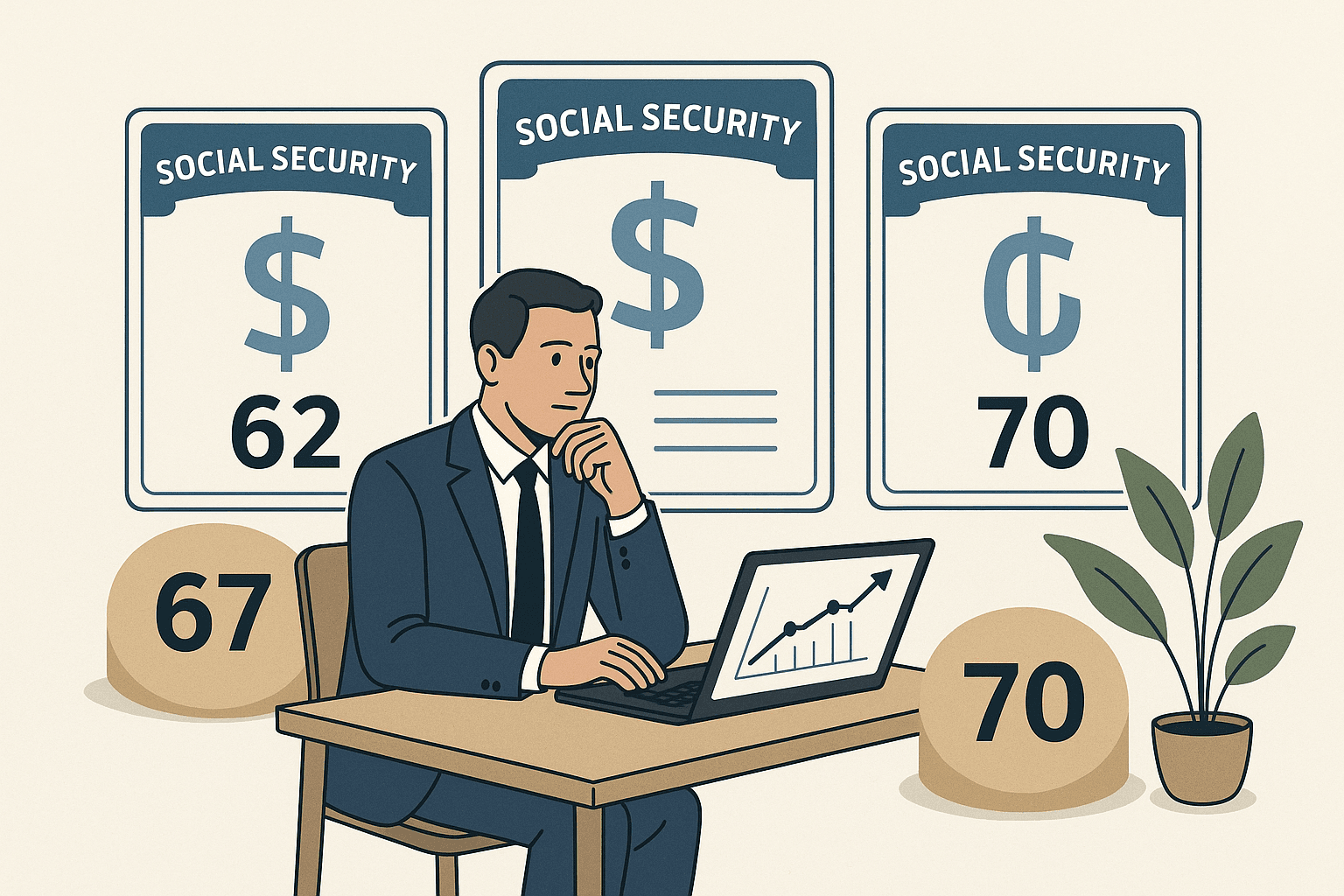
Social Security Benefits in 2026: 8 Strategies to Maximize What You Receive - Featured image

Last updated: May 1, 2026 | Reviewed by the SeniorSimple Editorial Team

The single most powerful decision you can make about Social Security is when to claim. Waiting from age 62 to age 70 increases your monthly benefit by up to 76% — a difference that compounds for the rest of your life and affects survivor benefits for a surviving spouse. But the right strategy isn't the same for everyone. This guide covers the 8 most important Social Security decisions and strategies, explained clearly so you can make the choice that fits your life.


Understanding the Basics Before You Strategize

Full Retirement Age (FRA): If you were born in 1960 or later, your FRA is 67. Born between 1955 and 1959, your FRA ranges from 66 years and 2 months to 66 years and 10 months. This is the age at which you receive your full Primary Insurance Amount (PIA).

Claiming range: You can claim as early as 62 or as late as 70. There is no benefit to waiting past 70.

The core math:

  • Claim at 62: Receive approximately 70% of your full benefit (if FRA is 67)
  • Claim at FRA (67): Receive 100% of your full benefit
  • Claim at 70: Receive approximately 124% of your full benefit

Use our Social Security Benefits Calculator to estimate your specific benefit at different claiming ages based on your actual earnings record.


Strategy 1: Delay Claiming If You Can — Each Year Adds 8%

For every year you delay claiming past your Full Retirement Age (up to age 70), your monthly benefit increases by 8% — guaranteed, with no market risk. This is called the Delayed Retirement Credit. It's one of the few guaranteed 8% annual "returns" available to retirees.

The compounding effect:

  • FRA benefit (age 67): $2,500/month (example)
  • Age 68: $2,700/month (+8%)
  • Age 69: $2,916/month (+8%)
  • Age 70: $3,100/month (+24% over FRA)

The break-even calculation: Most people break even on delayed claiming between ages 78 and 82 — meaning if you live past that age, delaying was mathematically the better choice. The Social Security Administration estimates the average 65-year-old will live to approximately 85 (men) or 87 (women).

Who benefits most from delaying: People in good health, those with family history of longevity, and married couples where one spouse had significantly higher earnings (see Strategy 3 on spousal survivor benefits).

Who may benefit from claiming earlier: Those with serious health conditions, limited financial resources who need income now, or individuals with shorter life expectancy based on health factors.


Strategy 2: Know Your Earnings Record — and Correct Errors

Social Security calculates your benefit based on your 35 highest-earning years. If you worked fewer than 35 years, zeros are averaged in — which lowers your benefit. Errors in your SSA earnings record are more common than most people realize and can reduce your benefit by hundreds of dollars monthly.

How to check your record:

  1. Create a My Social Security account at ssa.gov/myaccount
  2. Review your earnings history year by year
  3. Compare against your own tax records (W-2s, tax returns)
  4. Report discrepancies to the SSA in writing with documentation

What to look for:

  • Years where your earnings appear lower than they actually were
  • Missing earnings from self-employment
  • Gaps that may be incorrectly recorded
  • Earnings from early career jobs that may have been misattributed

The dollar impact: A $10,000 error in a single year's reported earnings can reduce your monthly benefit by $50–$100 — adding up to thousands of dollars over a 20-year retirement.


Strategy 3: Coordinate Spousal Benefits Strategically

Married couples have two Social Security benefits to work with — and the claiming decisions interact. A spouse who earned less (or didn't work) is entitled to up to 50% of their higher-earning spouse's FRA benefit. The strategy of having the higher earner delay to 70 while the lower earner claims earlier is one of the most effective legal ways to maximize lifetime household income.

How spousal benefits work:

  • The lower-earning spouse can claim their own benefit or up to 50% of the higher earner's FRA benefit — whichever is larger
  • Spousal benefits do not receive delayed retirement credits — there is no advantage for the lower earner to wait past their own FRA to claim spousal benefits
  • The higher earner must have filed before the lower earner can claim spousal benefits

A common effective strategy for couples:

  1. Lower earner claims at 62–65, providing household income
  2. Higher earner delays to 70, maximizing the larger benefit and future survivor benefit
  3. When the higher earner claims at 70, lower earner switches to spousal benefit if it exceeds their own benefit

This approach maximizes both lifetime income and survivor protection.


Strategy 4: Understand Survivor Benefits — They Can Be the Biggest Factor

When one spouse dies, the surviving spouse receives the larger of the two Social Security benefits — not both. This means the higher earner's decision to delay to 70 creates a larger survivor benefit that protects the remaining spouse, potentially for decades.

How survivor benefits work:

  • A surviving spouse can claim survivor benefits as early as age 60 (50 if disabled)
  • The survivor receives 100% of the deceased spouse's benefit (including any delayed retirement credits)
  • If the survivor has their own Social Security benefit, they receive the higher of the two

The survivor protection calculation:

  • Husband claims at 67 (FRA): $3,000/month
  • Husband claims at 70: $3,720/month
  • If husband dies first, wife's survivor benefit is $720/month higher for the rest of her life
  • Over 15 years, that difference is $129,600

For couples with a meaningful earnings gap, maximizing the higher earner's benefit through delayed claiming is often the most important financial planning decision they can make together.


Strategy 5: Understand the Earnings Test If You Work While Collecting

If you claim Social Security before your FRA and continue working, the earnings test may temporarily reduce your benefits. In 2026, if you earn more than $22,320/year before FRA, Social Security withholds $1 in benefits for every $2 above that threshold.

The important nuance: Benefits withheld due to the earnings test are not lost permanently. SSA recalculates your benefit at FRA and effectively gives you credit for the months benefits were withheld — increasing your monthly payment going forward.

After you reach FRA: The earnings test disappears entirely. You can earn any amount without any reduction to your Social Security benefit.

The practical takeaway: If you're still working and earning well, it often makes sense to delay claiming until FRA or later — you avoid the earnings test and earn delayed retirement credits simultaneously.


Strategy 6: Manage the Taxation of Your Benefits

Up to 85% of your Social Security benefits may be taxable at the federal level, depending on your "combined income" (adjusted gross income + nontaxable interest + half of Social Security benefits). This surprises many retirees who assumed Social Security was tax-free.

The thresholds (2026):

Filing Status Combined Income Portion of SS Taxable
Single Under $25,000 0%
Single $25,000–$34,000 Up to 50%
Single Over $34,000 Up to 85%
Married Filing Jointly Under $32,000 0%
Married Filing Jointly $32,000–$44,000 Up to 50%
Married Filing Jointly Over $44,000 Up to 85%

Strategies to reduce SS taxation:

  • Drawing from Roth IRA accounts (tax-free withdrawals don't count as combined income)
  • Timing large IRA withdrawals in years before you claim Social Security
  • Converting traditional IRA funds to Roth before claiming SS to reduce future RMD income
  • Managing capital gains realizations to stay below the thresholds

Many retirees reduce their effective Social Security tax burden substantially with thoughtful account withdrawal sequencing. A financial advisor or tax professional can help model this for your specific situation.


Strategy 7: Coordinate Social Security with Medicare Enrollment

If you claim Social Security at or after age 65, Medicare Part B premiums are automatically deducted from your Social Security benefit. This is seamless and convenient. But if you delay Social Security past 65, you must enroll in Medicare Part B separately — and missing your enrollment window triggers permanent premium penalties.

The Medicare enrollment rules:

  • Initial Enrollment Period: 7-month window centered on your 65th birthday (3 months before through 3 months after)
  • If you or your spouse has employer coverage, you may delay Part B without penalty — but rules are specific
  • The penalty for missing your IEP without employer coverage: 10% premium increase for every 12-month period you were eligible but didn't enroll — permanent

The interaction: Many people delay Social Security to 70 but must still enroll in Medicare at 65. These are separate decisions with separate enrollment windows.

For help understanding Medicare plan options alongside your Social Security timeline, see our Medicare Plans Comparison guide and Medicare Supplement Insurance guide.


Strategy 8: Know Your Options as a Divorced Spouse

If you were married for at least 10 years and are currently unmarried, you may be entitled to Social Security benefits based on your ex-spouse's earnings record — up to 50% of their FRA benefit. You don't need your ex-spouse's cooperation or even their knowledge. Claiming on their record does not reduce their benefit or their current spouse's benefit.

Requirements to claim divorced spousal benefits:

  • Marriage lasted at least 10 years
  • You are currently unmarried (or remarried after age 60)
  • You are at least 62 years old
  • Your own Social Security benefit is less than 50% of your ex's FRA benefit
  • Your ex must be at least 62 (even if they haven't claimed yet, if you've been divorced for 2+ years)

Survivor benefits for divorced spouses: If your ex-spouse dies, you may be entitled to 100% of their benefit as a survivor — applying the same rules as married spouses. This applies even if they remarried.

Many divorced individuals are unaware of this entitlement, particularly those who spent years out of the workforce.


Quick Reference: Social Security Claiming Decision Guide

Your Situation Generally Recommended Approach
Good health, married, higher earner Delay to 70 — maximize survivor protection
Good health, married, lower earner Consider claiming at 62–65 to provide income while spouse delays
Single, good health Delay to 70 if financially feasible
Poor health or limited life expectancy Consider claiming earlier; break-even may not be reached
Still working at 62–65 Consider delaying — earnings test and delayed credits both favor waiting
Divorced (10+ year marriage) Check divorced spousal benefit eligibility before claiming own benefit

Methodology

SeniorSimple reviewed this content using the Social Security Administration's official Program Operations Manual System (POMS), SSA.gov benefit calculation rules current as of May 2026, IRS Publication 915 (Social Security and Equivalent Railroad Retirement Benefits), and analysis from the Center for Retirement Research at Boston College. Benefit percentages and thresholds reflect 2026 rules. Tax thresholds have not been adjusted for inflation since 1984 and reflect current law.


Frequently Asked Questions

At what age should I claim Social Security?
There is no single right answer. The core trade-off: earlier claiming means more total checks but smaller monthly amounts; later claiming means fewer but larger checks. For most people in good health, delaying to FRA or age 70 maximizes lifetime income — especially for married couples where one spouse will outlive the other.

Can I claim Social Security and still work?
Yes. Before your FRA, the earnings test may reduce benefits if you earn more than $22,320/year (2026). After FRA, you can earn any amount with no reduction.

How do I apply for Social Security?
Apply online at ssa.gov/retirement, by phone at 1-800-772-1213, or in person at your local SSA office. Apply 3–4 months before you want benefits to begin.

What if I change my mind after claiming?
You can withdraw your application within 12 months of claiming and repay all benefits received — then refile later as if you never claimed. This is allowed only once. After 12 months, you can voluntarily suspend benefits at FRA or later to earn delayed credits going forward.

Does Social Security run out?
The Social Security Trust Fund is projected to face shortfalls by the mid-2030s under current law, but even in that scenario, ongoing payroll taxes would fund approximately 75–80% of scheduled benefits. Congress has historically acted to address funding gaps. Current retirees and near-retirees are expected to be largely protected by any legislative changes.

How does Social Security interact with a pension?
If you receive a pension from work not covered by Social Security (some state and local government jobs), the Windfall Elimination Provision (WEP) and Government Pension Offset (GPO) rules may reduce your Social Security benefit. Check with SSA directly if you have a non-covered pension.


Disclaimer: Social Security rules, benefit amounts, tax thresholds, and program details are subject to change by Congress and SSA regulation. Information in this article reflects rules in effect as of May 1, 2026. Benefit amounts used in examples are illustrative only — your actual benefit depends on your specific earnings history. This article is for informational purposes only and does not constitute financial, legal, or tax advice. Consult a qualified financial advisor, Social Security specialist, or the SSA directly for guidance specific to your situation.

Last updated: May 1, 2026. SeniorSimple reviews Social Security guides annually and when legislation changes.

Reviewed by the SeniorSimple Editorial Team — with warmth and respect for the decisions our readers are navigating.


Related Articles

Pension or Lump Sum? A 5-Step Framework for the $500K Retirement Decision - Featured image

Pension or Lump Sum? A 5-Step Framework for the $500K Retirement Decision

Choosing between a monthly pension and a lump sum is one of the most consequential — and irreversible — financial decisions most retirees make. This 5-step framework covers break-even analysis, health assessment, survivor benefit evaluation, investment capability, and tax implications so you can make the decision with clarity.

April 30, 2026Read More →

Stay Informed About Retirement Planning

Get expert insights and practical advice delivered to your inbox weekly.

Join 50,000+ seniors making informed retirement decisions.