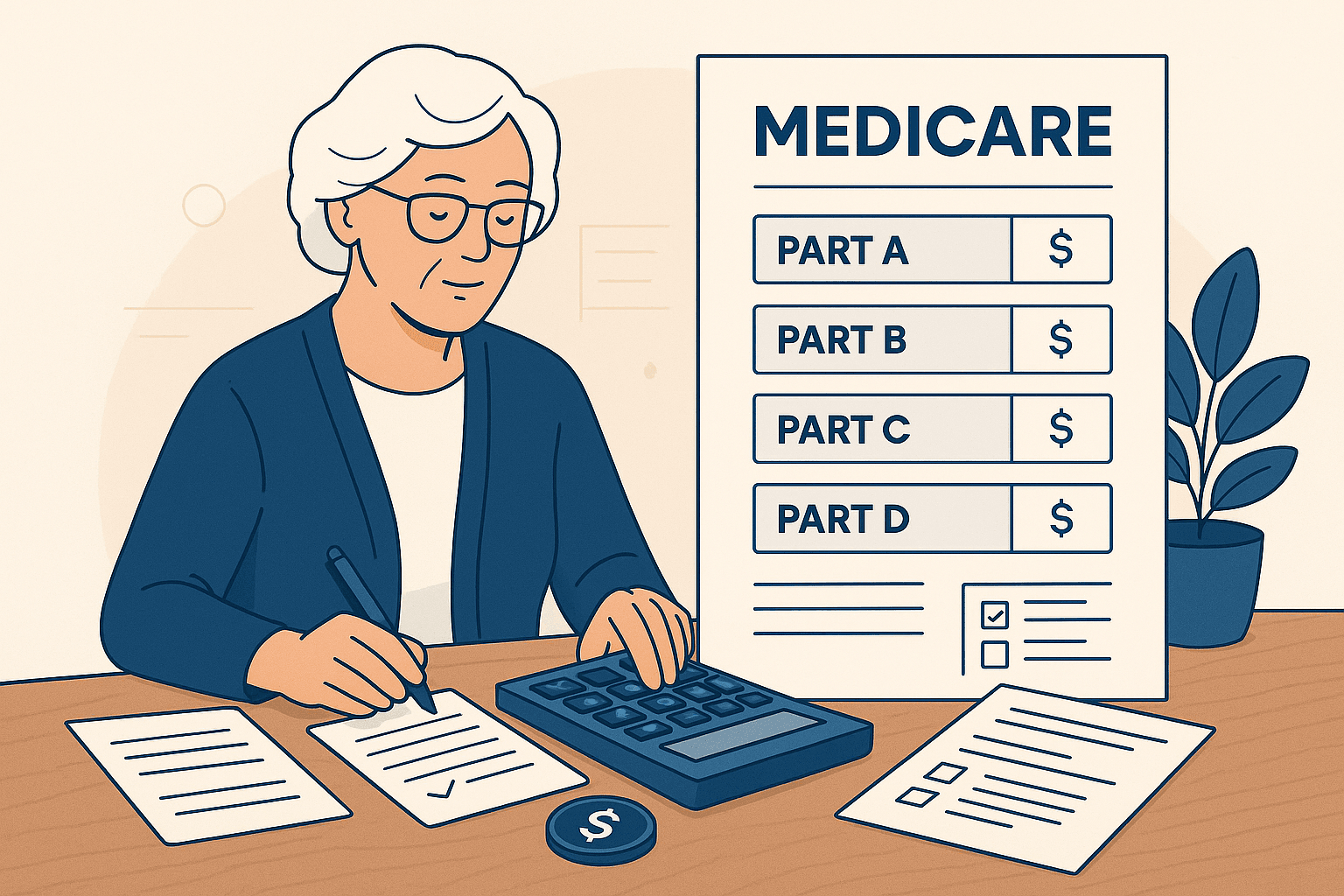
Original Medicare covers a great deal, but it leaves ten specific, predictable gaps: there is no annual cap on your out-of-pocket costs, and no routine coverage for dental, vision, hearing aids, long-term custodial care, most care outside the United States, prescription drugs, (learn more about long-term care insurance: 7 best policies of 2026 compared by coverage, cost, and value) (learn more about medicare cost calculator: complete guide to estimating your annual costs) (learn more about 6 retirement withdrawal strategies that protect your income in 2026) (learn more about rmd planning guide: master required minimum distributions) or routine foot care. The largest financial exposure by far is the missing out-of-pocket maximum paired with long-term custodial care — a single extended illness (learn more about medicare open enrollment 2027: 8 things every senior needs to know before october 15) or a few years in a nursing home can run into six figures with no ceiling. Every one of these gaps has a known solution path, and most of them are far cheaper to close at 65 than at 70.
This guide walks through each gap in plain language: what Medicare actually pays, what it doesn't, what it could cost you, and how to close it. No plan recommendations, no sales pitch — just the map.
How We Prioritized These Gaps
Not every gap deserves the same amount of your attention. A $60 dental cleaning and an unlimited hospital bill are not the same problem. We scored each gap on four factors:
| Factor |
Weight |
Why It Matters |
| Likelihood you'll hit it |
High |
A gap that affects nearly everyone beats a rare one, even if the rare one costs more. |
| Potential cost exposure |
High |
Uncapped exposure is categorically different from a known, budgetable expense. |
| How hard it is to fix later |
High |
Some gaps can be closed any year. Others close a door permanently after one window passes. |
| Timing sensitivity |
Medium |
Enrollment deadlines create penalties and denials that no amount of money later can undo. |
The gaps are ordered by that combined score, not by how often people ask about them. That's why the missing out-of-pocket maximum sits at number one and dental — the gap people ask about most — sits further down.
1. No Out-of-Pocket Maximum — Original Medicare has no annual spending ceiling
What Medicare covers: Part A covers inpatient hospital stays, skilled nursing after a qualifying hospital admission, hospice, and some home health. Part B covers doctor visits, outpatient care, lab work, durable medical equipment, and preventive services.
What it doesn't: Original Medicare does not stop charging you at any dollar amount. Employer plans and Marketplace plans have an out-of-pocket maximum. Original Medicare, on its own, does not.
Typical exposure: For 2026, the Part A hospital deductible is $1,736 per benefit period — and a benefit period restarts after you've been out of the hospital 60 days, so a bad year can trigger it more than once. Part B carries a $283 annual deductible for 2026, and then you pay 20% of the Medicare-approved amount for most services, with no ceiling on that 20%.
Original Medicare has no annual out-of-pocket maximum. After the Part B deductible, you pay 20% coinsurance on most outpatient care indefinitely. A serious cancer, cardiac, or surgical year can therefore produce tens of thousands of dollars in cost-sharing. Supplemental coverage — Medigap (learn more about best medicare supplement plans (medigap) for 2026: plan g vs. plan n compared) or Medicare Advantage — is what creates a ceiling.
How To Close This Gap
Two paths. A Medicare Supplement (Medigap) policy pays some or all of the deductibles and the 20% coinsurance, effectively creating a ceiling through predictable monthly premiums. A Medicare Advantage (Part C) plan replaces how you receive Medicare and is legally required to include an annual out-of-pocket maximum, though you must generally use the plan's network and accept prior-authorization rules.
What It Costs You To Wait
This is the expensive one. Medigap is guaranteed-issue only during your one-time Medigap Open Enrollment window. Wait past it and, in most states, insurers can medically underwrite you — meaning they can charge more or decline you outright. Medicare Advantage remains available in any Annual Enrollment Period, so waiting narrows your options rather than closing them.
2. Long-Term Custodial Care — the biggest and most misunderstood gap
What Medicare covers: Short-term skilled care. After a qualifying inpatient hospital stay, Part A covers skilled nursing facility care for up to 100 days per benefit period — days 1–20 at no coinsurance, and for 2026, $217 per day for days 21–100.
What it doesn't: Custodial care — help with bathing, dressing, eating, toileting, and moving around — when that's the only care you need. That is the care most people actually end up needing, and Medicare does not pay for it. Not in a nursing home, not in assisted living, not at home.
Typical exposure: Private nursing home and assisted living costs vary enormously by state and facility; the U.S. Department of Health and Human Services' LongTermCare.gov maintains current national and state figures worth checking for your area. Multi-year stays commonly run into six figures.
Medicare does not pay for long-term custodial care. It covers up to 100 days of skilled nursing per benefit period after a qualifying hospital stay, and only while skilled care is required. Assisted living, memory care, and ongoing help with daily activities are paid privately, by long-term care insurance, or by Medicaid after you spend down assets.
How To Close This Gap
Long-term care insurance or a hybrid life/LTC policy, purchased while you're still insurable. Personal savings earmarked for care. Medicaid, which does cover long-term care but only after strict income and asset limits are met — rules vary by state. PACE (Program of All-Inclusive Care for the Elderly) is an often-overlooked option that combines Medicare and Medicaid services to keep nursing-home-eligible adults living at home; availability depends on your county.
What It Costs You To Wait
Long-term care insurance is medically underwritten and gets more expensive every year you age. A diagnosis can make you uninsurable overnight. Medicaid also applies a look-back period to asset transfers, so last-minute rearranging of finances generally does not work.
3. Routine Dental — cleanings, fillings, dentures, and extractions
What Medicare covers: Only dental work that is an inseparable part of a covered medical procedure — for example, a jaw reconstruction after an accident, or a dental exam required before certain organ transplants or cardiac valve procedures.
What it doesn't: Cleanings, exams, X-rays, fillings, crowns, root canals, extractions, dentures, and implants.
Typical exposure: Ongoing and predictable. A cleaning-and-exam schedule is budgetable; a full-mouth restoration or implant series is not, and often runs into thousands.
Original Medicare does not cover routine dental care — no cleanings, fillings, dentures, or implants. Coverage exists only for dental services integral to a covered medical procedure. Options include a Medicare Advantage plan with a dental benefit, a standalone dental plan, a dental discount plan, a dental school clinic, or a community health center with sliding-scale fees.
How To Close This Gap
Many Medicare Advantage plans include a dental allowance — read the annual maximum carefully, since it's often modest. Standalone dental insurance is sold independently of Medicare. Dental schools and federally qualified health centers offer substantially reduced fees. Note that Medigap does not add dental coverage.
What It Costs You To Wait
Dental plans commonly impose waiting periods of six to twelve months on major work, so enrolling after a problem appears rarely helps with that problem. Deferred dental care also has a habit of turning inexpensive fillings into expensive crowns.
4. Routine Vision and Eyeglasses — exams for glasses aren't covered
What Medicare covers: Medically necessary eye care. Part B covers annual glaucoma screening for people at high risk, diabetic retinopathy exams, treatment for macular degeneration, and cataract surgery — plus one pair of standard eyeglasses or contact lenses after cataract surgery with an intraocular lens implant.
What it doesn't: Routine eye exams for the purpose of prescribing glasses, and eyeglasses or contacts in every other circumstance.
Typical exposure: A routine exam plus frames and lenses is a modest but recurring annual or biennial cost.
Medicare covers medically necessary eye care, including cataract surgery and diabetic eye exams, but not routine refraction exams or eyeglasses. The one exception is a single pair of corrective lenses after cataract surgery with a lens implant. Vision benefits are available through many Medicare Advantage plans or a standalone vision plan.
How To Close This Gap
A Medicare Advantage plan with a vision allowance, a standalone vision plan, or simply paying cash — vision is one of the few gaps where retail competition keeps costs manageable. Ask whether your plan's allowance covers the exam, the frames, or both.
What It Costs You To Wait
Low financial risk, but there is a health risk: skipped exams delay the detection of glaucoma and diabetic retinopathy, both of which are treatable early and much harder to reverse late.
5. Hearing Aids and Fitting Exams — the devices are entirely on you
What Medicare covers: Diagnostic hearing and balance exams when your doctor orders them to determine whether you need medical treatment. Part B also covers certain audiology services without a physician referral in limited circumstances.
What it doesn't: Hearing aids themselves, and the exams performed specifically to fit them.
Typical exposure: Prescription hearing aids have historically been one of the largest out-of-pocket device costs seniors face. Since 2022, FDA-regulated over-the-counter hearing aids for perceived mild-to-moderate hearing loss have been legal to buy without a prescription, which has meaningfully changed the low end of the price range.
Original Medicare does not cover hearing aids or fitting exams. It does cover diagnostic hearing exams ordered by a doctor to evaluate a medical problem. Coverage paths include Medicare Advantage plans with a hearing benefit, standalone hearing plans, over-the-counter hearing aids, and VA benefits for eligible veterans.
How To Close This Gap
Medicare Advantage hearing benefits, standalone hearing plans, over-the-counter devices, and — for eligible veterans — VA hearing aid benefits, which are among the most generous available. Some state Medicaid programs cover hearing aids for adults.
What It Costs You To Wait
Untreated hearing loss is associated with social withdrawal and communication difficulty with clinicians, which quietly makes every other part of your care harder.
6. Prescription Drugs — Parts A and B don't cover the medicines you take at home
What Medicare covers: Part B covers a narrow set of drugs — those administered in a clinical setting, certain infusions, and some vaccines.
What it doesn't: The prescriptions you fill at a pharmacy and take at home. That requires Part D, either as a standalone plan or bundled into a Medicare Advantage plan (an MA-PD).
Typical exposure: For 2026, Part D includes an annual out-of-pocket cap of $2,100 on covered drugs — a genuinely significant protection created by the Inflation Reduction Act, and one many people don't know exists. Plans also carry a deductible (capped by law at an amount that changes yearly — verify the current figure at Medicare.gov) and their own formularies, which determine whether your specific drug is covered at all.
Original Medicare Parts A and B do not cover most prescription drugs taken at home. You need a standalone Part D plan or a Medicare Advantage plan that includes drug coverage. For 2026, Part D caps your annual out-of-pocket spending on covered drugs at $2,100. Formularies differ by plan, so check your specific medications before enrolling.
How To Close This Gap
Enroll in standalone Part D alongside Original Medicare, or choose an MA-PD plan. Run your actual medication list through the Medicare.gov Plan Finder — the cheapest premium is frequently not the cheapest total cost once your drugs are priced. If your income and resources are limited, Extra Help (the Low-Income Subsidy) can dramatically reduce premiums, deductibles, and copays.
What It Costs You To Wait
See gap 10. The Part D late-enrollment penalty is permanent.
7. Care Outside the United States — travel coverage is the exception, not the rule
What Medicare covers: In rare situations — for example, an emergency in the U.S. where a foreign hospital is closer, or care aboard a ship within six hours of a U.S. port.
What it doesn't: Essentially all other health care received outside the United States and its territories.
Typical exposure: A hospitalization abroad, plus medical evacuation, which is frequently the larger of the two bills.
Medicare generally does not cover health care outside the United States, with narrow exceptions for certain border and shipboard emergencies. Some Medigap plans (notably Plans C, D, F, G, M, and N) include foreign travel emergency coverage up to a lifetime maximum. Travel medical insurance with evacuation coverage is the other common solution.
How To Close This Gap
A Medigap plan that includes foreign travel emergency benefits, purchased before you travel, or a travel medical policy for each trip. Confirm whether medical evacuation is included — it usually is not automatic.
What It Costs You To Wait
None, as long as you buy before you leave. Coverage purchased after an incident does not apply.
8. Routine Foot Care — the podiatry gap that catches diabetics off guard
What Medicare covers: Medically necessary foot care — treatment for injuries, foot conditions like hammertoe or heel spurs, and, importantly, diabetic foot exams and therapeutic shoes or inserts for people with diabetes-related nerve damage.
What it doesn't: Routine care such as cutting or removing corns and calluses, routine nail trimming, and hygienic maintenance, when no underlying medical condition makes it necessary.
Typical exposure: Small per-visit, but recurring for people with mobility or vision limits who cannot safely care for their own feet.
Medicare does not cover routine foot care such as nail trimming or callus removal absent a qualifying medical condition. It does cover medically necessary podiatry, and it covers annual diabetic foot exams plus therapeutic footwear for beneficiaries with diabetic peripheral neuropathy. Documentation from your doctor is what moves care from routine to covered.
How To Close This Gap
Ask your physician to document any qualifying condition. Some Medicare Advantage plans include routine podiatry. Otherwise, paying out of pocket or using a community clinic is the practical route.
What It Costs You To Wait
Minor foot problems in people with diabetes or poor circulation can escalate quickly. This is a small gap with a disproportionate downstream risk.
9. Skilled Nursing and Home Health Limits — coverage is narrower than most people assume
What Medicare covers: Skilled nursing facility care for up to 100 days per benefit period following a qualifying inpatient hospital stay, and home health services (intermittent skilled nursing, physical therapy, speech therapy) when you're homebound and under a plan of care.
What it doesn't: Care once you are no longer improving-or-maintaining under a skilled plan, 24-hour home care, meal delivery, homemaker services, and personal care when that's the only care you need. The distinction between "observation status" and formal inpatient admission also matters enormously — observation days generally do not count toward the three-day inpatient requirement for skilled nursing coverage.
Medicare's skilled nursing benefit requires a qualifying inpatient hospital stay and covers a maximum of 100 days per benefit period. Time spent in the hospital under observation status does not count toward that requirement. Ask the hospital directly whether you have been admitted as an inpatient or are under observation — the answer determines your coverage.
How To Close This Gap
Ask about your admission status every day you're in the hospital, in writing if necessary. Medigap helps with the days 21–100 coinsurance. Long-term care planning covers what happens after day 100.
What It Costs You To Wait
Nothing to buy here — this gap is closed by asking the right question at the right moment.
10. The Late-Enrollment Penalty Trap — a gap in your timing, not your coverage
What Medicare covers: Timely enrollees, at standard rates.
What it doesn't: Forgive a late start. If you don't sign up for Part B when first eligible and don't have qualifying coverage from active employment, your premium rises 10% for each full 12-month period you could have had it — for as long as you have Part B. The Part D penalty adds roughly 1% of the national base beneficiary premium for each month you went without creditable drug coverage, also permanently.
Typical exposure: For context, the standard Part B premium for 2026 is $202.90 per month, with higher amounts for higher-income beneficiaries under IRMAA (thresholds change annually — verify yours at Medicare.gov). A 30% Part B penalty is therefore a permanent surcharge on top of that.
Medicare's Part B and Part D late-enrollment penalties are permanent, not one-time. Part B adds 10% per missed 12-month period; Part D adds about 1% of the national base premium per uncovered month. Coverage from active employment (yours or a spouse's) generally protects you. Retiree coverage, COBRA, and Marketplace plans generally do not.
How To Close This Gap
Confirm in writing whether your current coverage is "creditable." Enroll during your Initial Enrollment Period — the seven months surrounding your 65th birthday — or use a Special Enrollment Period when employer coverage ends. If you already have a penalty, Extra Help eliminates the Part D penalty for those who qualify.
What It Costs You To Wait
The penalty compounds for life. This is the single cheapest gap to avoid and one of the most expensive to have.
Quick Comparison
| Gap |
Covered by Original Medicare? |
Closed by Medigap? |
Closed by Medicare Advantage? |
Another program? |
| No out-of-pocket maximum |
No |
Yes — pays deductibles/coinsurance |
Yes — plans must have a MOOP |
Medicaid, MSPs |
| Long-term custodial care |
No |
No |
Rarely; some supplemental benefits |
Medicaid, PACE, LTC insurance |
| Routine dental |
No |
No |
Often, with an annual cap |
Standalone dental, dental schools, FQHCs |
| Routine vision / glasses |
No (except post-cataract) |
No |
Often, with an allowance |
Standalone vision plan |
| Hearing aids |
No |
No |
Often, with an allowance |
OTC devices, VA, some Medicaid |
| Prescription drugs |
No |
No |
Yes, via MA-PD plans |
Standalone Part D, Extra Help |
| Care outside the U.S. |
Rarely |
Some plans, to a lifetime max |
Varies; usually emergency only |
Travel medical insurance |
| Routine foot care |
No |
No |
Sometimes |
Documented medical necessity |
| Skilled nursing past 100 days |
No |
No |
No |
Medicaid, PACE, LTC insurance |
| Late-enrollment penalties |
N/A |
No |
No |
Extra Help removes the Part D penalty |
The Timing Traps
Most of what people regret about Medicare is timing, not price. Three windows matter more than everything else.
Medigap Open Enrollment. This is a one-time, six-month window that starts the month you're 65 and enrolled in Part B. During it, you can buy any Medigap policy sold in your state at the standard rate, regardless of your health history. After it closes, most states allow insurers to medically underwrite — they can raise your price or decline you because of a diagnosis. A handful of states have broader ongoing protections; most do not. If there is one date to circle in this entire guide, it's this one. People commonly choose Medicare Advantage at 65, develop a condition at 70, and discover they can no longer switch to Medigap.
Part B and Part D late enrollment. Your Initial Enrollment Period runs seven months: the three months before your 65th birthday month, that month, and the three months after. If you're still working and covered by an employer plan based on active employment, you generally get a Special Enrollment Period later without penalty. Retiree coverage, COBRA, and Marketplace plans do not count that way — this is where most penalties are born.
Annual windows. Medicare Open Enrollment runs October 15 to December 7 each year, for changes effective January 1. The Medicare Advantage Open Enrollment Period runs January 1 to March 31, allowing people already in an MA plan to switch plans or return to Original Medicare. Neither of these windows restores guaranteed-issue Medigap rights in most states.
Where To Get Free, Unbiased Help
You do not have to figure this out alone, and you do not have to talk to anyone earning a commission.
- State Health Insurance Assistance Program (SHIP) — free, unbiased, one-on-one Medicare counseling in every state, staffed by trained counselors who do not sell insurance. Find your state's program at shiphelp.org.
- Medicare.gov Plan Finder — the official tool for comparing Part D and Medicare Advantage plans using your actual medication list and pharmacies.
- 1-800-MEDICARE (1-800-633-4227) — the official Medicare helpline, available 24 hours a day, seven days a week.
- Your State Insurance Department — the right place for Medigap pricing rules, which companies sell what in your state, and complaints.
- Medicare Savings Programs and Extra Help — administered through your state Medicaid office and the Social Security Administration, these can cover Part B premiums and sharply reduce drug costs for people with limited income and resources. Many who qualify never apply.
How We Researched This
This guide draws on Medicare.gov coverage documentation, the Centers for Medicare & Medicaid Services (CMS) annual cost announcements for 2026, the official Medicare & You handbook, KFF research on Medicare benefit design and out-of-pocket spending, and LongTermCare.gov for custodial care context. Where a dollar amount changes annually, we have either stated the 2026 figure explicitly or pointed you to Medicare.gov rather than print a number that may be out of date by the time you read this. We excluded plan-specific pricing entirely, since Medigap and Medicare Advantage costs vary by state, ZIP code, and carrier. Last updated: August 21, 2026.
Frequently Asked Questions
Does Medicare cover nursing home care?
Only short-term skilled care, and only after a qualifying inpatient hospital stay — up to 100 days per benefit period, with daily coinsurance after day 20. Medicare does not cover long-term custodial nursing home care, which is the type most residents need. That is paid privately, by long-term care insurance, or by Medicaid.
Does Medicare cover dental work?
No, not routine dental. Cleanings, fillings, crowns, root canals, extractions, and dentures are not covered by Original Medicare. The only exception is dental care that is an inseparable part of a covered medical procedure. Many Medicare Advantage plans include a capped dental benefit.
Does Medicare pay for hearing aids?
No. Original Medicare covers diagnostic hearing exams ordered by a doctor but not hearing aids or the exams to fit them. Options include Medicare Advantage hearing benefits, standalone hearing plans, FDA-regulated over-the-counter hearing aids, and VA benefits for eligible veterans.
What is the out-of-pocket maximum for Medicare?
Original Medicare has none. There is no annual ceiling on what you can spend on Part A and Part B cost-sharing. Medicare Advantage plans are required to have an annual out-of-pocket maximum, and Medigap policies limit your exposure by paying deductibles and coinsurance on your behalf.
Can I be denied a Medigap plan because of my health?
Yes, after your one-time six-month Medigap Open Enrollment window closes. During that window — which begins when you're 65 and enrolled in Part B — insurers must sell you any policy they offer at the standard rate. Afterward, most states permit medical underwriting. Certain guaranteed-issue rights still apply in specific situations; your State Insurance Department can confirm your state's rules.
Do I need Part D if I don't take any prescriptions?
Usually yes. Going without creditable drug coverage triggers a permanent late-enrollment penalty of roughly 1% of the national base beneficiary premium for every month you were uncovered. Many people in this position enroll in a low-premium plan purely to avoid the penalty and to be covered if a prescription becomes necessary.
What happens if I need medical care while traveling abroad?
Medicare generally will not pay. Coverage exists only in narrow border and shipboard emergency situations. Some Medigap plans include foreign travel emergency benefits up to a lifetime maximum, typically with a deductible and coinsurance. For extended travel, a travel medical policy that includes medical evacuation is the more complete solution.
Medigap or Medicare Advantage — which closes more gaps?
They close different ones. Medigap closes the cost gaps in Original Medicare — deductibles and the uncapped 20% coinsurance — while keeping access to any provider who accepts Medicare, but it adds no dental, vision, hearing, or drug coverage. Medicare Advantage caps your annual spending and frequently bundles drug, dental, vision, and hearing benefits, but restricts you to a network and uses prior authorization. Neither covers long-term custodial care.
What is the Part D out-of-pocket cap for 2026?
For 2026, Part D limits your annual out-of-pocket spending on covered prescription drugs to $2,100. Once you reach it, you pay nothing further for covered drugs for the rest of the calendar year. Drugs not on your plan's formulary do not count toward the cap.
How do I know if my current coverage counts as creditable?
Your plan administrator must tell you in writing, and employers are required to send a creditable coverage notice each year. Coverage based on active employment — yours or your spouse's — generally protects you from Part B and Part D penalties. Retiree coverage, COBRA, and Marketplace plans generally do not. Keep those notices; you may need them to prove you qualify for a Special Enrollment Period.
Important Disclosures
This article is for educational and informational purposes only. It is not insurance advice, medical advice, or a recommendation of any specific plan, insurer, or product, and it is not an offer or solicitation to sell insurance. Medicare coverage rules, premiums, deductibles, coinsurance amounts, income-related thresholds, and enrollment periods change annually and vary by state — verify all current-year figures at Medicare.gov or by calling 1-800-MEDICARE before making any decision. SeniorSimple is not affiliated with, endorsed by, or connected to the Centers for Medicare & Medicaid Services, the Social Security Administration, or any federal or state government agency. For free, unbiased, one-on-one help, contact your State Health Insurance Assistance Program (SHIP).