If you are wondering whether it is time for assisted living, the answer is usually found in a pattern (learn more about tax-free retirement income: complete guide) (learn more about best medicare advantage plans in 2026: top rated plans by coverage, cost, and star rating) (learn more about reverse mortgage strategy guide: unlock your home's equity for retirement), not a single bad day. The clearest signals are: a fall or near-fall, medication mistakes, unexplained weight loss, declining hygiene, a home that has stopped being maintained, unsafe driving or getting lost, social withdrawal, (learn more about social security optimization calculator) and caregiver burnout. As a rule of thumb, assisted living is the right level of care when someone needs hands-on help with two (learn more about medicare advantage vs medicare supplement) (learn more about glp-1 drugs covered by medicare in 2026: ozempic, wegovy, mounjaro & more) or more daily activities but does not need round-the-clock skilled nursing. Below are the eight signs that matter most — plus three situations that look alarming but usually mean you still have time.
This guide is built from CDC injury data, the CareScout (Genworth) 2025 Cost of Care Survey, and National Center for Assisted Living resident data — not from a placement agency's referral list.
How We Weighted These Signs
Not every worrying moment is a reason to move. We ranked these eight signs by how strongly each one predicts that staying home is no longer safe or sustainable.
| Criteria |
Weight |
Why It Matters |
| Safety risk |
High |
Some signs carry an immediate risk of injury or hospitalization; those move to the top regardless of how mild they look. |
| Pattern vs. incident |
High |
One missed pill is a bad day. A month of missed pills is a care gap. Frequency is the real signal. |
| Reversibility |
Medium |
Problems fixed by a grab bar, a pill organizer, or six weeks of physical therapy are not assisted-living problems. |
| Caregiver sustainability |
Medium |
Care that only works because one family member is running themselves into the ground is not a stable plan. |
Data sources: CDC Older Adult Fall Prevention, National Center for Assisted Living (NCAL) / AHCA, CareScout 2025 Cost of Care Survey, Alzheimer's Association 2026 Facts and Figures.
1. A Fall — or a Near-Fall Nobody Mentioned
Urgency: High
What it signals: Mobility or balance decline that the home can no longer accommodate
A fall is the single strongest predictor that home is no longer safe. The CDC reports that about 1 in 4 adults age 65 and older fall each year — more than 14 million people — and falls are the leading cause of injury in that age group, driving roughly 3 million emergency department visits annually. Critically, fewer than half of older adults tell their doctor they fell.
What this looks like in practice: New bruises with vague explanations. Furniture-walking — steadying against walls and countertops to cross a room. A parent who has quietly stopped using the stairs, or who now sleeps in a recliner because getting out of bed is hard.
Why it matters: The first fall rarely causes the crisis. The second one does. A hip fracture frequently converts a manageable situation into a hospital-to-rehab-to-placement sequence made under pressure, with no time to compare communities or costs.
Not a red flag if: The fall had a clear, one-time cause — a new medication being titrated, an inner-ear infection, an icy step — and balance returns to baseline after treatment. Ask the physician for a formal gait and balance assessment before drawing conclusions.
2. Medications Are Missed, Doubled, or Quietly Stockpiled
Urgency: High
What it signals: Executive-function decline, which rarely reverses on its own
Medication management is one of the first complex tasks to slip, and it is dangerous in both directions — skipped doses and accidental double doses. A cabinet holding months of unopened refills is direct evidence that prescriptions are not being taken as written.
What this looks like in practice: Pill organizers filled inconsistently or not at all. Refills requested far too early or far too late. Expired bottles mixed in with current ones. Confusion about which pill does what, in someone who used to manage it easily.
Why it matters: Uncontrolled blood pressure, blood sugar, or anticoagulation produces exactly the emergencies — strokes, falls, hospital admissions — that end independent living abruptly.
Not a red flag if: The regimen recently changed and the confusion is new. Ask the pharmacist for blister-pack or pre-sorted dosing first; that solves a meaningful share of these cases without a move.
3. Weight Loss, Spoiled Food, or an Empty Kitchen
Urgency: High
What it signals: Nutrition, shopping, or cooking capacity has broken down
Open the refrigerator. It is the most honest room in the house. Expired staples, untouched groceries, or nothing but condiments tell you meals are not happening — regardless of what anyone says on the phone.
What this looks like in practice: Clothes and rings visibly looser. The same untouched casserole across two visits. Burned pans, or a stove that is no longer used. Meals reduced to cereal, toast, and snacks.
Why it matters: Unintentional weight loss in older adults is associated with muscle loss, weakness, and higher fall and hospitalization risk. It also compounds quickly — a weaker person shops and cooks less, which drives further decline.
Not a red flag if: Appetite dipped during a short illness or a grief period and recovered. Meal delivery or a few hours of weekly in-home help may be the right-sized fix.
4. Personal Hygiene and Grooming Have Slipped
Urgency: Medium-High
What it signals: Difficulty with activities of daily living (ADLs), or depression
Bathing is the most common activity assisted living residents need help with, according to NCAL. It is also the one people conceal longest, because admitting it feels like a loss of dignity.
What this looks like in practice: Wearing the same outfit across multiple visits. Body odor or unwashed hair in someone who was always meticulous. Skipped dental care. Laundry piling up untouched.
Why it matters: Bathing avoidance is often a safety problem before it is a motivation problem — the tub has become frightening. Untreated, it leads to skin breakdown, infections, and social withdrawal.
Not a red flag if: The barrier is purely physical and fixable. A walk-in shower, grab bars, and a shower chair resolve many cases. If someone is capable but has stopped caring, screen for depression before assuming it is dementia.
5. The House Has Stopped Being Maintained
Urgency: Medium
What it signals: The home has outgrown the person's capacity to manage it
What this looks like in practice: Unopened mail stacked on the counter. Utility shutoff notices or unpaid bills in a lifelong on-time payer. Burned-out bulbs left dark. A yard, a car, or a pet visibly neglected.
Why it matters: Financial disorganization is one of the earliest markers of cognitive change, and it exposes the household to late fees, lapsed insurance, and scam losses. Neglected home upkeep also creates its own hazards — bad lighting, clutter in walkways, and unaddressed repairs.
Not a red flag if: The house is simply too big and the person is otherwise sharp. That is a housing problem, not a care problem. Our home downsizing checklist for seniors walks through the alternative path.
6. Driving Has Become Unsafe — or They Got Lost on a Familiar Route
Urgency: High if disorientation is present
What this looks like in practice: New dents and scrapes that get explained away. Tickets or near-misses. Family members quietly refusing to ride along. Getting lost on a route driven for decades.
Why it matters: Slower reaction time is an aging issue and can be managed by limiting night and highway driving. Getting lost on a familiar route is a different category entirely — it points to spatial disorientation, and it frequently precedes wandering. Wandering is the point at which most families need to evaluate secured memory care rather than standard assisted living. If that is your situation, start with assisted living vs memory care vs nursing home to identify the right level of care.
Not a red flag if: Driving has narrowed voluntarily and sensibly — daytime, local, familiar roads — with no disorientation. That is good judgment, not decline.
7. Withdrawal From People They Used to See
Urgency: Medium
What it signals: Isolation, which independently accelerates decline
What this looks like in practice: Dropped church, club, or card-game attendance. Unreturned calls. Declining invitations with vague reasons. Days spent entirely alone with the television on.
Why it matters: Social isolation in older adults is associated with higher risks of cognitive decline, depression, and mortality. It is also self-reinforcing: less contact means fewer people positioned to notice the next problem.
Not a red flag if: The person is genuinely content and still connected on their own terms. Introversion is not decline. Look for loss of contact against their own wishes — usually caused by not driving, hearing loss, or embarrassment about mobility.
8. The Family Caregiver Is Running Out of Road
Urgency: High — and the most frequently ignored
The Alzheimer's Association reports that in 2025, nearly 13 million family members and friends provided more than 19 billion hours of unpaid care, valued at over $446 billion. Those hours come out of someone's health, job, and marriage.
What this looks like in practice: A daughter or spouse who has stopped sleeping through the night. Missed work, missed medical appointments of their own, canceled plans. Resentment, guilt, or short-temperedness that was never there before. Care that only functions because one person absorbs all of it.
Why it matters: Caregiver collapse is the most common trigger for an emergency placement — the worst circumstances under which to choose a community. Moving before the breaking point preserves choice, price negotiation, and often the family relationship itself.
Not a red flag if: The load is genuinely shared and respite is built in. If one person is doing everything, it is a red flag no matter how capable they are.
Quick Comparison: Urgency and Next Step
| Sign |
Urgency |
What It Usually Signals |
Typical Next Step |
| Falls / near-falls |
High |
Mobility and balance decline |
Physician gait assessment; home safety evaluation |
| Medication errors |
High |
Executive-function decline |
Pharmacist blister packs; cognitive screening |
| Weight loss / empty fridge |
High |
Nutrition breakdown |
Physician workup; meal delivery or in-home aide |
| Hygiene decline |
Medium-High |
ADL difficulty or depression |
Bathroom modification; depression screening |
| Unmaintained home / finances |
Medium |
Cognitive change or home overload |
Bill autopay; downsizing evaluation |
| Unsafe driving or getting lost |
High if disoriented |
Reaction time vs. spatial disorientation |
Driving evaluation; memory care assessment |
| Social withdrawal |
Medium |
Isolation, hearing loss, mobility loss |
Transportation help; hearing check |
| Caregiver burnout |
High |
Care plan is unsustainable |
Respite care; begin touring communities |
The threshold to remember: assisted living generally fits when someone needs help with two or more ADLs — bathing, dressing, toileting, transferring, eating — but does not require 24-hour skilled nursing. NCAL reports that about 38% of assisted living residents receive help with three or more ADLs, and 53% of residents are 85 or older.
3 Signs It Probably Isn't Time Yet
1. One bad week after an illness or hospitalization. Post-hospital deconditioning looks dramatic and often reverses substantially with physical therapy. Give rehab a real window — typically 6 to 12 weeks — before making a permanent decision.
2. They need help with exactly one thing. One ADL gap is usually an in-home care problem, not a move. A few hours a week of home care costs meaningfully less than a full assisted living apartment, which CareScout put at a national median of $6,200 per month ($74,400 per year) in 2025.
3. The house is the problem, not the person. Stairs, a big yard, and distance from family are housing constraints. A single-level condo, a 55+ community, or independent living may solve the whole thing while preserving autonomy.
How We Researched This
This guide draws on published data from the CDC's Older Adult Fall Prevention program, the National Center for Assisted Living resident profile, the CareScout (Genworth) 2025 Cost of Care Survey, and the Alzheimer's Association 2026 Facts and Figures report. We prioritized signs that appear consistently in clinical ADL assessments over anecdotal warning-sign lists, and we deliberately excluded signs that are commonly listed but poorly predictive on their own — such as forgetting names or misplacing objects — because normal age-related memory change is routinely mistaken for dementia.
Last updated: August 28, 2026. We review this guide every six months, and whenever new federal cost or fall data is published.
Frequently Asked Questions
What are the main signs it's time for assisted living?
The main signs are falls or near-falls, medication mistakes, unexplained weight loss, declining hygiene, a neglected home or finances, unsafe driving or getting lost, social withdrawal, and caregiver burnout. A move is usually warranted when several appear together and persist over weeks, not days.
How many signs should be present before we consider a move?
There is no fixed number, but the practical threshold most families use is help needed with two or more activities of daily living, plus at least one safety-related sign such as a fall or a medication error. A single sign in isolation is usually solvable at home.
At what age do most people move into assisted living?
Most residents are in their mid-80s. NCAL reports that 53% of assisted living residents are 85 or older. Age itself is not the trigger — function is.
How much does assisted living cost?
The CareScout (Genworth) 2025 Cost of Care Survey put the national median at $6,200 per month, or $74,400 per year — up about 5% from the prior year. Costs vary widely by state and by care level, and most communities charge a tiered care fee on top of base rent.
Does Medicare pay for assisted living?
No. Medicare does not cover room and board in assisted living. It may cover specific medical services delivered there, such as physician visits or short-term skilled therapy. Long-term custodial care is generally paid privately, through long-term care insurance, or through Medicaid waiver programs in some states.
What's the difference between assisted living and a nursing home?
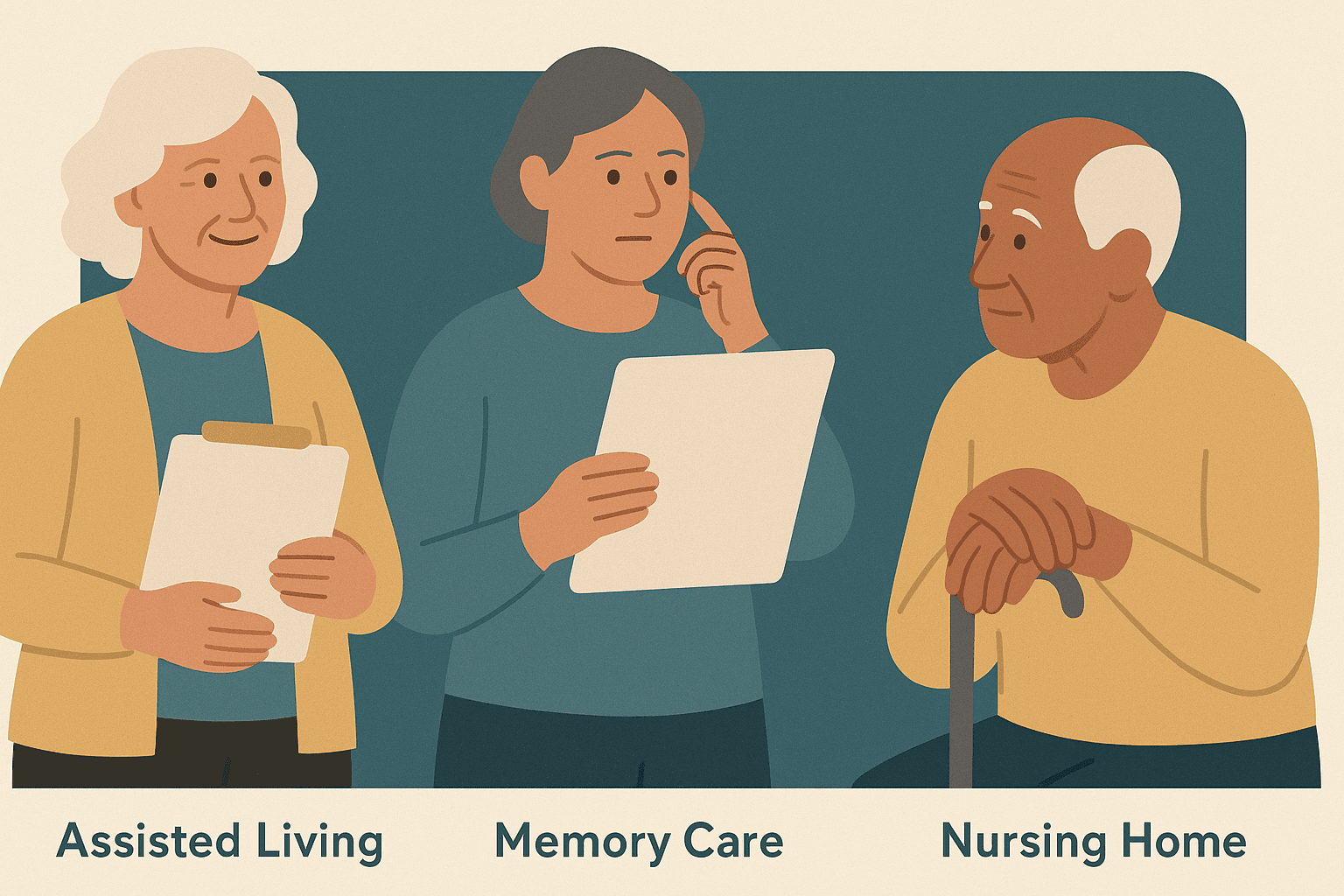
Assisted living provides help with daily activities in a residential setting; nursing homes provide 24-hour skilled nursing care for medically complex needs. Memory care is a secured setting for dementia. See our full comparison of assisted living vs memory care vs nursing home.
How long do people typically stay in assisted living?
Roughly 22 months on average, according to NCAL data, though the range is wide. A substantial share of residents eventually transition to skilled nursing as care needs increase.
What if my parent refuses to move?
Refusal is normal and rarely permanent. Start with the specific problem rather than the destination — for example, "the bathroom isn't safe" rather than "you need assisted living." Touring two or three communities without committing frequently changes the picture, as does hearing the recommendation from a physician rather than a family member.
Is assisted living the right choice if there's a dementia diagnosis?
Sometimes. Early-stage dementia is often managed well in standard assisted living. Once wandering, exit-seeking, or significant disorientation appear, a secured memory care setting is usually the safer fit — and moving directly there avoids a second disruptive move.
Can in-home care replace assisted living?
Often, up to a point. In-home care is typically more affordable when needs are limited to a few hours a day. As hours increase toward around-the-clock coverage, the cost usually exceeds assisted living while providing less social contact and no on-site emergency response.
What should we do first if we recognize several of these signs?
Schedule a full medical evaluation, including a cognitive screen and a medication review. Reversible causes — urinary tract infections, thyroid problems, medication interactions, depression, and vitamin deficiencies — mimic decline and are treatable. Rule those out before making a permanent housing decision.
Important Disclosures
This content is for informational and educational purposes only. It is not medical, legal, or financial advice, and it is not a substitute for evaluation by a licensed physician or a geriatric care professional. Care costs, Medicaid eligibility rules, and assisted living regulations vary significantly by state and change frequently. Consult qualified professionals before making care, housing, or financial decisions.
Reviewed by the SeniorSimple Editorial Team. We do not accept payment from senior living communities or placement agencies in exchange for coverage or ranking.