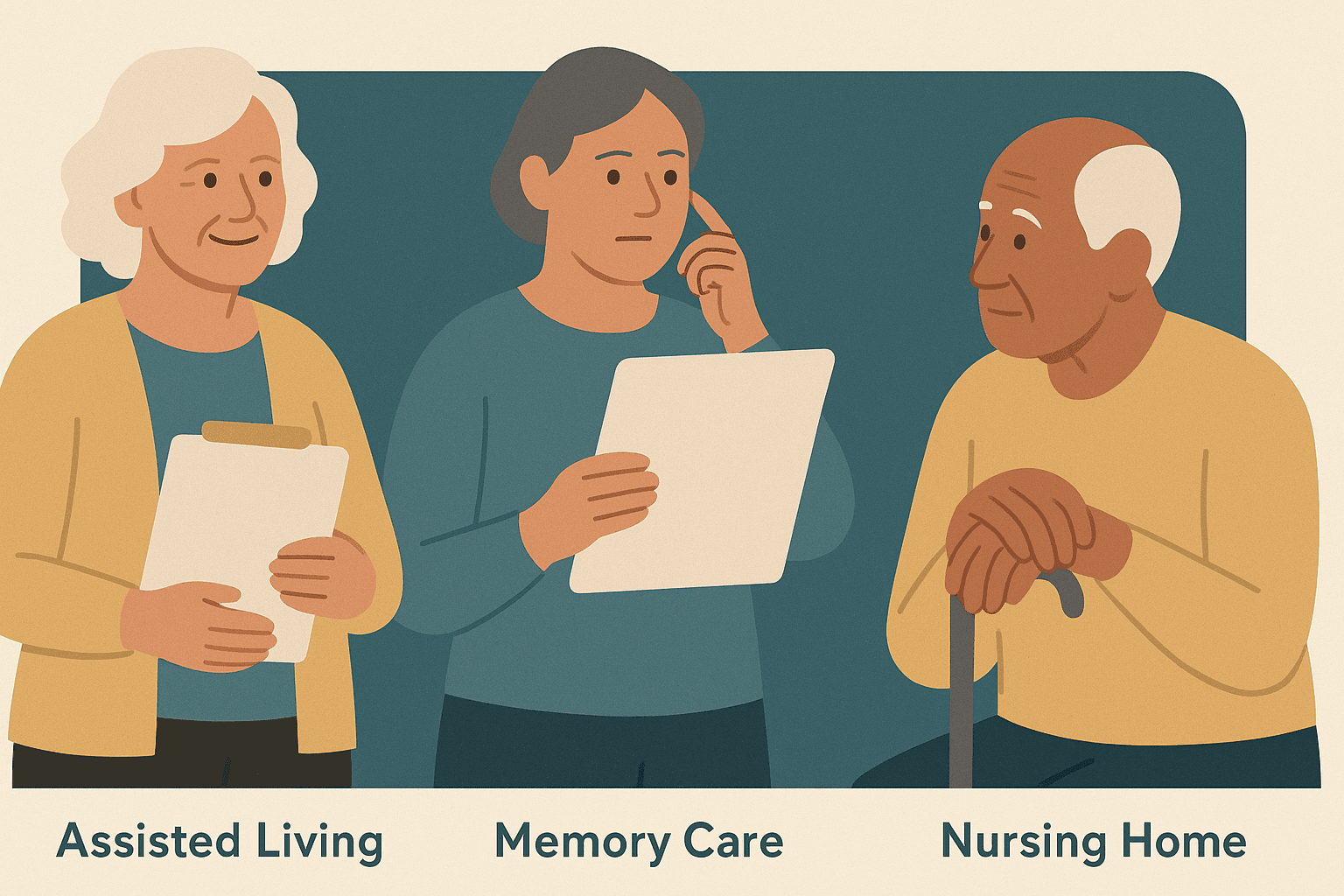
If you are comparing assisted living, memory care, and a nursing home, the short answer is this: assisted living is for someone who needs help with daily tasks but is medically stable, memory care is assisted living with dementia-trained staff and a secured building, (learn more about "annuities explained: secure your retirement income with confidence") (learn more about allianz index advantage annuity review: independent analysis (2026)) and a nursing home is for someone who needs skilled nursing supervision around the clock. Cost rises in that same order. We compared five care settings on the level of daily help, on-site medical care, dementia safety, typical monthly cost, (learn more about pacific life annuity review: all products rated & compared (2026)) (learn more about medicare advantage vs medicare supplement) and who actually pays. This guide is for families trying to match a real situation to the right level of care (learn more about tax-free retirement income: complete guide) (learn more about rmd planning guide: master required minimum distributions).
How We Compared These Care Options
We looked at each setting through the five questions families actually ask, in the order they matter.
| Criteria |
Weight |
Why It Matters |
| Level of daily help |
High |
Bathing, dressing, medication, and meals drive the decision more than any brochure feature. |
| Medical care on site |
High |
A licensed nurse on duty around the clock is the line between assisted living and a nursing home. |
| Dementia safety |
High |
Wandering risk changes the answer entirely, even when everything else looks the same. |
| Typical monthly cost |
Medium |
The gap between settings can be $3,000 a month or more. |
| Who pays |
Medium |
Medicare covers far less of this than most families expect. |
Data sources: the Genworth and CareScout Cost of Care Survey, Medicare.gov coverage rules, Medicaid.gov home and community-based services guidance, the Alzheimer's Association, and state assisted living licensure summaries.
Two facts shape everything below. First, Medicare does not pay for long-term custodial care — the help with bathing, dressing, and meals that assisted living and memory care are built around. Second, the Alzheimer's Association estimates that about 7 million Americans age 65 and older are living with Alzheimer's, which is why memory care exists as its own category rather than a wing of assisted living.
1. In-Home Care — For Staying Put With Some Help
Best for: Someone who is safe at home but needs help a few hours a day
Medical care: Non-medical aide, or a home health nurse with a doctor's order
Typical cost: Roughly $6,000 a month for around 44 hours a week of aide time; far less for part-time help
In-home care sends an aide to the house for a set number of hours to help with bathing, dressing, meals, laundry, and reminders. It is often the least expensive option when the need is a few hours a day, and the most expensive when the need becomes round-the-clock.
Pros
- Keeps familiar surroundings, which matters enormously in early dementia
- Scales hour by hour, so you pay for what you use
- No move, no downsizing, no waiting list
Cons
- Cost passes assisted living once you need more than about 40 to 50 hours a week
- Aides call out sick, and coverage gaps land on the family
- Nights are the hardest hours to staff and the hours when falls happen
Who This Is Best For
A parent who is managing well overall and needs help with a handful of tasks. It stops being the right answer when the need becomes overnight supervision, or when the house itself is the hazard — our aging in place home modification checklist covers the changes that can buy more time at home safely.
2. Assisted Living — Daily Help, Not Medical Care
Best for: Someone medically stable who needs help with daily tasks and would benefit from company
Medical care: Medication management and aide support; a nurse on call or on site part of the day
Typical cost: Roughly $5,000 to $6,000 a month nationally, with wide state variation
Assisted living is an apartment in a residential community with meals, housekeeping, activities, and staff available around the clock to help with bathing, dressing, and medications. It is licensed as a residential setting, not a medical one — that distinction is what separates it from a nursing home.
Pros
- Meals, transportation, and social contact are built in, which addresses isolation
- Costs less than a nursing home for someone who does not need skilled nursing
- Most communities allow a spouse to move in together
Cons
- Not equipped for around-the-clock nursing needs, and residents are asked to move when needs exceed the license
- Base rent usually excludes care levels, so the real bill is often higher than the quoted rate
- Medicare pays nothing toward the room or the daily help
Who This Is Best For
Someone who is falling behind on cooking, medications, and housekeeping but is medically steady and not at risk of wandering. It is the wrong setting for someone who needs a nurse at 3 a.m., and usually the wrong setting for moderate to advanced dementia.
3. Memory Care — Assisted Living Built Around Dementia
Best for: Someone with Alzheimer's or another dementia who is at risk of wandering or getting lost
Medical care: Same licensing as assisted living in most states, with dementia-trained staff and higher staffing ratios
Typical cost: Roughly 20 to 30 percent above assisted living in the same market, commonly $6,500 to $8,000 a month
Memory care is a secured neighborhood — often a locked wing or a separate building — where staff are trained in dementia behaviors, the layout is designed to reduce confusion, and the day is structured around routine. In most states it is licensed under the same rules as assisted living, so the meaningful differences are staffing, security, and programming rather than medical capability.
Pros
- Secured exits address wandering, which is the single biggest safety risk in mid-stage dementia
- Staff are trained to respond to agitation and sundowning without escalating it
- Structured routines and simplified layouts genuinely reduce distress
Cons
- Costs several thousand dollars a year more than standard assisted living
- Quality varies widely, and "memory care" is a marketing term in some states rather than a licensure category
- Still not a skilled nursing setting, so a serious medical decline can force a second move
Who This Is Best For
A parent with a dementia diagnosis who has gotten lost, left the stove on, or become unsafe alone — even if they are physically healthy. It is not necessary for early memory changes where supervision at home is still working, and it is not enough on its own when advanced medical needs are present.
4. Nursing Home (Skilled Nursing Facility) — Around-the-Clock Medical Care
Best for: Someone who needs licensed nursing supervision every day
Medical care: Registered and licensed practical nurses on duty 24 hours, physician oversight, on-site therapy
Typical cost: Roughly $8,500 to $10,000 a month, semi-private to private room
A nursing home is a licensed medical facility. It is the right setting for wound care, feeding tubes, complex medication regimens, recovery from a serious hospitalization, or advanced dementia with medical complications. It is also the only setting on this list where Medicare pays anything meaningful, and only for short rehabilitation stays.
Pros
- Licensed nursing coverage 24 hours a day, which no other setting provides
- Medicare Part A can cover a short rehabilitation stay after a qualifying inpatient hospital stay
- Medicaid pays for long-term nursing home care once assets are spent down, in every state
Cons
- The most expensive and least homelike setting on this list
- Semi-private rooms are the norm, and privacy is limited
- Medicare's rehabilitation coverage ends quickly, and families are often surprised by the cutoff
Who This Is Best For
Someone whose needs are medical rather than custodial. If the honest answer to "what do they need help with" is nursing tasks, no amount of assisted living add-on care will substitute.
5. Continuing Care Retirement Community — Paying Now to Avoid Moving Later
Best for: A couple planning ahead who can fund a large entrance fee
Medical care: Varies by tier, from independent living through skilled nursing on one campus
Typical cost: A six-figure entrance fee in many communities, plus a monthly fee
A continuing care retirement community, sometimes called a life plan community, lets a resident move from independent living to assisted living to skilled nursing without leaving the campus. You are buying continuity — and, in some contracts, a cap on future care costs.
Pros
- One move instead of three, which spares an aging parent repeated upheaval
- Some contracts limit what care will cost later
- Couples with different care needs can stay on the same campus
Cons
- Entrance fees are large and refundability terms vary sharply between contracts
- Financial health of the community matters, and residents carry that risk
- Rarely a fit once a crisis has already happened
Who This Is Best For
Healthy couples in their late sixties or seventies who are planning deliberately and have the assets. It is not a realistic answer for a family making a decision in a hospital hallway this week.
Quick Comparison
| Setting |
24-Hour Licensed Nursing |
Secured for Dementia |
Typical Monthly Cost |
Medicare Pays? |
Medicaid Pays? |
| In-home care |
No |
No |
Varies by hours |
Limited home health only |
Sometimes, via waiver |
| Assisted living |
No |
No |
$5,000–$6,000 |
No |
Varies by state waiver |
| Memory care |
No |
Yes |
$6,500–$8,000 |
No |
Varies by state waiver |
| Nursing home |
Yes |
Often |
$8,500–$10,000 |
Short rehab stays only |
Yes, after spend-down |
| CCRC |
On the nursing tier |
On the memory tier |
Entrance fee + monthly |
Same rules by tier |
Rarely |
Costs are national medians from the most recent Genworth and CareScout Cost of Care Survey. Actual prices vary by more than double between states.
How We Researched This
This comparison draws on cost data from the Genworth and CareScout Cost of Care Survey, coverage rules published by Medicare.gov and Medicaid.gov, dementia prevalence figures from the Alzheimer's Association, and state licensure summaries describing how assisted living and memory care are regulated. We compared settings on daily help, nursing coverage, dementia security, cost, and payment sources. We did not rank individual communities, because quality varies far more within a category than between categories. Last updated: August 2026. We review this guide twice a year.
Paying for care is its own decision, and it is usually the harder one. Families commonly combine savings, long-term care insurance, veterans benefits, and home equity — our look at what Medicare does not cover explains the gaps most people discover too late, and our review of common reverse mortgage myths covers one option families ask about when a house is the largest remaining asset.
Frequently Asked Questions
What is the main difference between assisted living and memory care?
Memory care is assisted living with a secured building, dementia-trained staff, and higher staffing ratios. In most states the two share the same license. The practical difference is that memory care is designed for someone who might walk out the door and not find their way back.
Does Medicare pay for assisted living or memory care?
No. Medicare does not cover room, board, or custodial care in assisted living or memory care. It may cover specific medical services delivered there, such as a doctor visit or physical therapy, but the monthly bill is yours.
Does Medicare pay for a nursing home?
Only for short-term skilled care. Medicare Part A can cover up to 100 days in a skilled nursing facility per benefit period after a qualifying inpatient hospital stay, with the first 20 days fully covered and a daily coinsurance after that. It does not cover long-term custodial nursing home stays.
Who pays for long-term nursing home care?
Medicaid is the largest payer of long-term nursing home care in the United States, once a person has spent down assets to their state's limit. Before that point, families typically pay privately or draw on long-term care insurance.
Is memory care worth the extra cost over assisted living?
It is worth it when wandering, exit-seeking, or repeated confusion is present. If those risks are not present, standard assisted living usually meets the need at a lower price. The extra cost buys security and trained staff, not medical capability.
When is it time to move from assisted living to a nursing home?
When the need shifts from help to nursing — repeated falls with injury, wound care, feeding difficulty, or medical instability that requires a licensed nurse on duty overnight. Most assisted living communities will tell you directly when a resident has exceeded their license.
Can a couple stay together if only one needs memory care?
Sometimes. Many communities offer assisted living and memory care on one campus, which lets a spouse live nearby and visit daily, though usually not in the same apartment. Continuing care retirement communities are built around this exact situation.
How much does memory care cost per month?
National medians generally run 20 to 30 percent above assisted living in the same market, commonly $6,500 to $8,000 a month. Costs in high-cost states can exceed $10,000, and rural markets can run well below the national median.
Do veterans have help paying for assisted living?
Yes, in some cases. The VA Aid and Attendance benefit adds to a monthly pension for veterans and surviving spouses who need help with daily activities and who meet service and financial requirements. It is applied for through the VA and can take months to process.
What should I ask on a tour?
Ask what the base rate includes and what triggers a care-level increase, what the staffing ratio is overnight, what conditions would require a resident to move out, and how many residents moved out last year and why. The answer to that last question tells you more than the brochure does.
Important Disclosures
This guide is for general education about senior care options and does not constitute medical, legal, or financial advice. Costs, licensure rules, and benefit amounts change annually and vary substantially by state. Medicare and Medicaid coverage depends on individual eligibility and circumstances — verify current rules at Medicare.gov and with your state Medicaid agency. Consult a licensed professional before making care or financial decisions for yourself or a family member.
Written and reviewed by the SeniorSimple Editorial Team. We explain retirement and senior care options plainly, so families can make a decision with the facts in front of them.