Step-by-Step: How to Estimate Your Benefit Before You Claim
Step 1: Create or log into your my Social Security account.
Visit ssa.gov/myaccount. Your account shows your full earnings history and projects your benefit at 62, your FRA, and 70.
Step 2: Audit your earnings history for errors.
Errors in SSA records are more common than most people expect. A year recorded as zero or with incorrect income permanently reduces your benefit. Check every year against your W-2s or tax returns and correct any errors while you still have documentation readily available.
Step 3: Use the SSA's online calculators.
The Retirement Estimator at ssa.gov/estimator projects your benefit using your actual earnings record across different claiming ages. The visual difference between claiming at 62 vs. 70 is often the most persuasive argument for waiting.
Step 4: Model your break-even age.
The break-even age is the point at which total lifetime benefits from waiting catches up to early claiming. For most people comparing age 62 to age 70, the break-even lands between ages 81 and 83. Expecting to live past that threshold is the core case for delayed claiming.
Step 5: Factor in spousal and survivor considerations.
If you are married, both spouses' claiming decisions interact. The higher-earning spouse's decision to delay to 70 is especially powerful because that benefit also becomes the survivor benefit — directly affecting the surviving spouse's income for the rest of their life.
Choosing When to Claim: A Decision Framework
There is no single correct answer, but these questions help most people identify the best approach.
Are you in good health and expect to live past 82? If yes, delayed claiming is likely worth it financially. The break-even analysis strongly favors waiting for people with average or above-average longevity.
Do you need the income now? If you have retired and cannot cover expenses from savings or other income, claiming before FRA may be a financial necessity rather than a strategy choice — and that is a valid reality.
Are you still working and earning above the earnings test limit? If yes, claiming before FRA creates a withholding situation that is rarely advantageous. Wait.
What is your spouse's benefit and health situation? The higher earner delaying to 70 has an outsized effect on total household lifetime income, because that benefit becomes the survivor benefit if the higher earner dies first.
Have you confirmed what benefit types you qualify for? Many people do not realize they are eligible for spousal, divorced-spouse, or survivor benefits on top of or instead of their own benefit. Verify all options before you file.
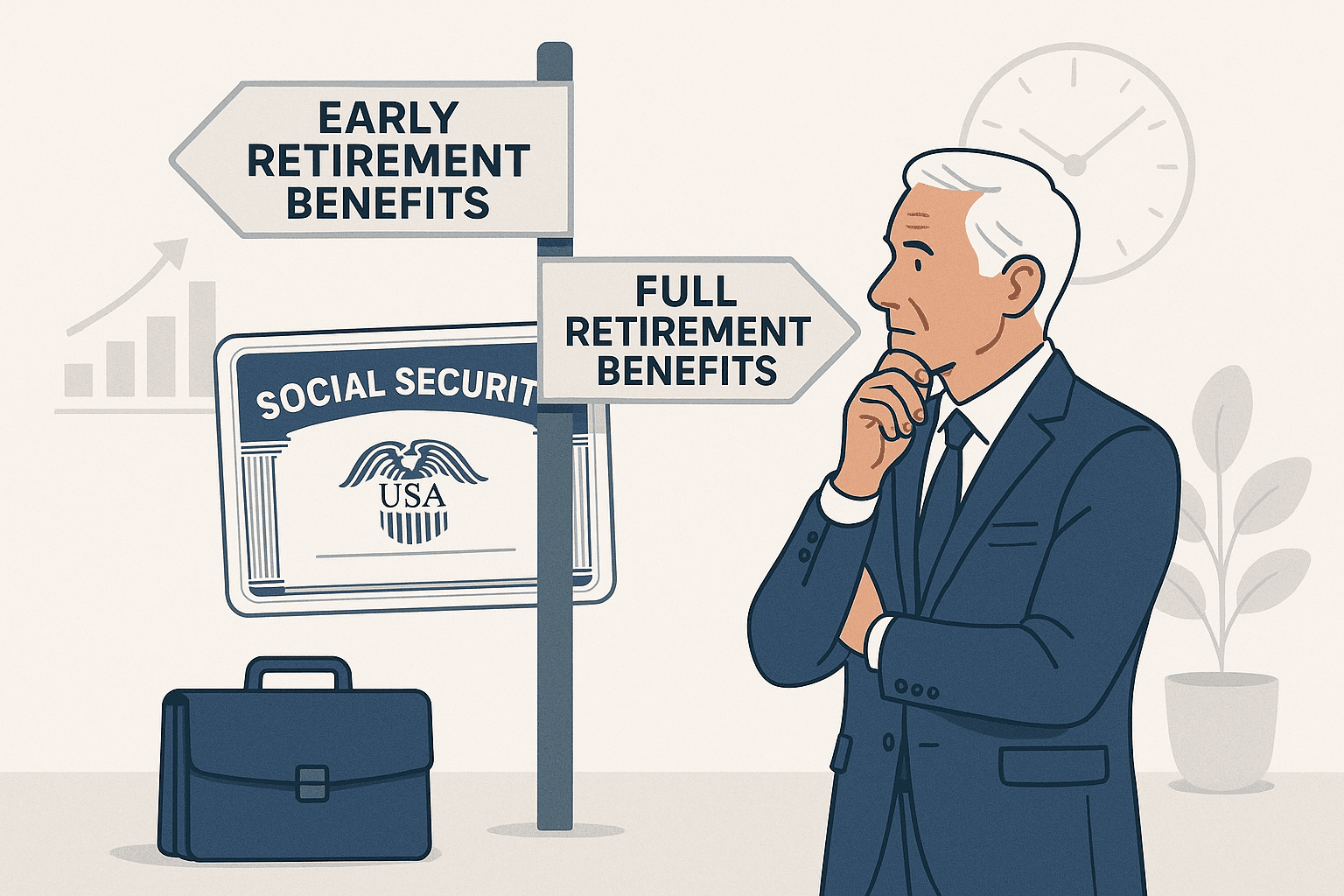
For comprehensive strategies, see: Social Security Benefits in 2026: 8 Strategies to Maximize What You Receive and Early vs Full Retirement Benefits: Which Claiming Age Is Right for You?.
Common Mistakes to Avoid
Claiming at 62 by default. Many people file the moment they are eligible — not because it is optimal, but because they did not realize they had a meaningful choice. For most people in good health with some retirement savings, even waiting two or three years beyond 62 produces a measurably better lifetime outcome.
Never reviewing your earnings record. Errors go unchallenged because most people never look. Each uncorrected mistake permanently reduces your benefit. Checking once a year takes five minutes.
Missing spousal and survivor strategies. A married couple has far more flexibility than a single individual. Coordinated claiming — who files first, at what age — can add $50,000 to $150,000+ in total household lifetime benefits compared to both spouses simply claiming at 62.
Underestimating longevity. Americans consistently underestimate their own life expectancy. A 65-year-old today has roughly a 50% chance of living past 85, and a married couple has nearly a 50% chance that at least one partner lives past 90. Strategies built only around average life expectancy carry real longevity risk.
Overlooking the tax implications. Up to 85% of Social Security benefits can be included in taxable income depending on your total retirement income. This is not a penalty — it is a federal income tax rule. Knowing how it works allows you to time IRA withdrawals, Roth conversions, and other income events intelligently.
Ignoring the earnings test while working. Claiming early and earning above the limit means withheld benefits, a complex recalculation later, and often a net loss in present value. Workers with meaningful income should generally wait.
Costs, Taxes, and What You Actually Keep
Federal Income Tax on Social Security
Whether your benefits are taxed depends on your combined income: adjusted gross income plus nontaxable interest plus 50% of your Social Security benefits.
| Combined Income (Single Filer) |
Taxable Portion of Benefits |
| Under $25,000 |
0% |
| $25,000 to $34,000 |
Up to 50% |
| Over $34,000 |
Up to 85% |
| Combined Income (Married Filing Jointly) |
Taxable Portion of Benefits |
| Under $32,000 |
0% |
| $32,000 to $44,000 |
Up to 50% |
| Over $44,000 |
Up to 85% |
These thresholds have not been indexed for inflation since 1983 — so more retirees find their benefits partially taxable every year.
State Income Tax
About 13 states currently tax Social Security benefits to some degree. The majority of states fully exempt Social Security. State tax treatment is a meaningful factor in retirement relocation decisions.
Medicare Premium Deductions
If you are enrolled in Medicare, Part B premiums are deducted from your Social Security check before you receive it. The standard 2026 premium is $202.90/month. Income-related IRMAA surcharges can push this to $628.90/month for the highest earners.
The Social Security Trust Fund
The trustees project that the combined trust funds can pay 100% of scheduled benefits through approximately 2033 to 2035. Without legislative changes, incoming payroll taxes would then cover roughly 77-80% of benefits. Congress has historically acted before such shortfalls — the 1983 reform is the precedent — and most analysts expect legislative action before a cut occurs. Current retirees and those within 10 years of retirement are at minimal risk.
Frequently Asked Questions
How many years does Social Security use to calculate my benefit?
The SSA uses your 35 highest-earning years, indexed for wage inflation. Missing years count as zero and pull your average down.
What is the maximum Social Security benefit in 2026?
The maximum monthly benefit for someone retiring at their Full Retirement Age in 2026 is approximately $3,918. Reaching the maximum requires earning at or above the taxable wage base for 35 years.
Can I increase my benefit by working past my Full Retirement Age?
Yes, in two ways. Delaying your claim earns you 8% per year up to age 70. And if your current earnings replace a zero or low-earning year in your top 35, your AIME rises, increasing your PIA.
What happens to my Social Security if I get divorced?
If you were married at least 10 years and have not remarried, you can claim up to 50% of your ex-spouse's PIA at your FRA. This does not reduce your ex-spouse's benefit.
Does my spouse's income affect my own Social Security calculation?
No. Your retirement benefit is calculated entirely from your own earnings record. Your spouse's income only matters if you are claiming a spousal benefit.
Can I claim Social Security and still work?
Yes. After Full Retirement Age, you can earn any amount without affecting your benefit. Before FRA, the earnings test may reduce your benefit if you earn above $22,320 in 2026 — though withheld amounts are returned as a higher benefit at FRA.
What if I claimed early and changed my mind?
If you claimed within the last 12 months, you can withdraw your application, repay all benefits received, and restart later. This one-time withdrawal resets your benefit as if you never claimed. If you are past the 12-month window and have reached FRA, you can voluntarily suspend your benefit to earn delayed credits until age 70.
How does the COLA work?
The SSA measures the Consumer Price Index for Urban Wage Earners (CPI-W) each year. If it rises from Q3 of the prior year to Q3 of the current year, all benefits increase by that percentage the following January. The 2026 COLA was 2.5%.
What is Full Retirement Age for someone born in 1960 or later?
For anyone born in 1960 or later, Full Retirement Age is 67. Claiming before 67 permanently reduces your benefit; each month you delay past 67 (up to 70) permanently increases it.
I am a teacher or government employee. How did the Social Security Fairness Act affect me?
The Social Security Fairness Act, signed January 5, 2025, repealed the Windfall Elimination Provision and Government Pension Offset. If you received a government pension not covered by Social Security and had your benefit reduced under these rules, your benefit has been recalculated upward and you should have received retroactive payments to January 2024. Contact the SSA if you have not seen this update.
Can Social Security run out before I retire?
Your earned benefit cannot be taken away — Social Security is a legal obligation. The trustees project that without legislative changes, the combined trust funds could be depleted around 2033-2035, after which payroll taxes alone would cover approximately 77-80% of scheduled benefits. Congress has historically acted before such shortfalls, and most analysts expect some combination of revenue and benefit adjustments to be made before that point.
How do I check my earnings history for errors?
Create a free account at ssa.gov/myaccount. Your complete earnings history by year is there. Compare it against your W-2s or tax returns. Contact the SSA with documentation to correct any discrepancy.
What is the difference between PIA and my actual monthly benefit?
Your Primary Insurance Amount (PIA) is the theoretical full benefit at your Full Retirement Age — the reference point for all adjustments. Your actual monthly benefit is your PIA reduced or increased based on how many months before or after your FRA you claim.
Conclusion: Your Social Security Benefit Is Not Fixed — You Can Influence It
Social Security responds to the decisions you make throughout your career and at the moment you claim. The levers you control:
- Work toward 35 full earning years — every zero in your record costs you.
- Check your earnings history for errors — correct them while you still have records.
- Run claiming-age scenarios before you decide — the numbers are often more striking than people expect.
- Coordinate with your spouse — the higher earner delaying to 70 is one of the most powerful income strategies available to couples.
- Plan for the tax treatment — knowing how Social Security interacts with your IRA withdrawals and other income lets you sequence distributions for less tax.
The gap between an informed Social Security strategy and simply claiming at 62 can exceed $100,000 in lifetime income — and for married couples, often substantially more.
Continue building your retirement income plan:
This guide is for educational purposes only and does not constitute financial, legal, or tax advice. Social Security rules are complex and change frequently. Benefit amounts and thresholds cited reflect 2026 figures and are subject to annual adjustment. Consult a qualified financial advisor or contact the Social Security Administration at 1-800-772-1213 or ssa.gov for guidance specific to your situation. Last reviewed June 2026.