The Break-Even Calculation
The break-even age tells you how old you need to live to for delaying to pay off.
Formula:
Break-even age = Age you start claiming + (Extra monthly benefit from delay ÷ Monthly benefit you'd have received earlier) × Months you delayed
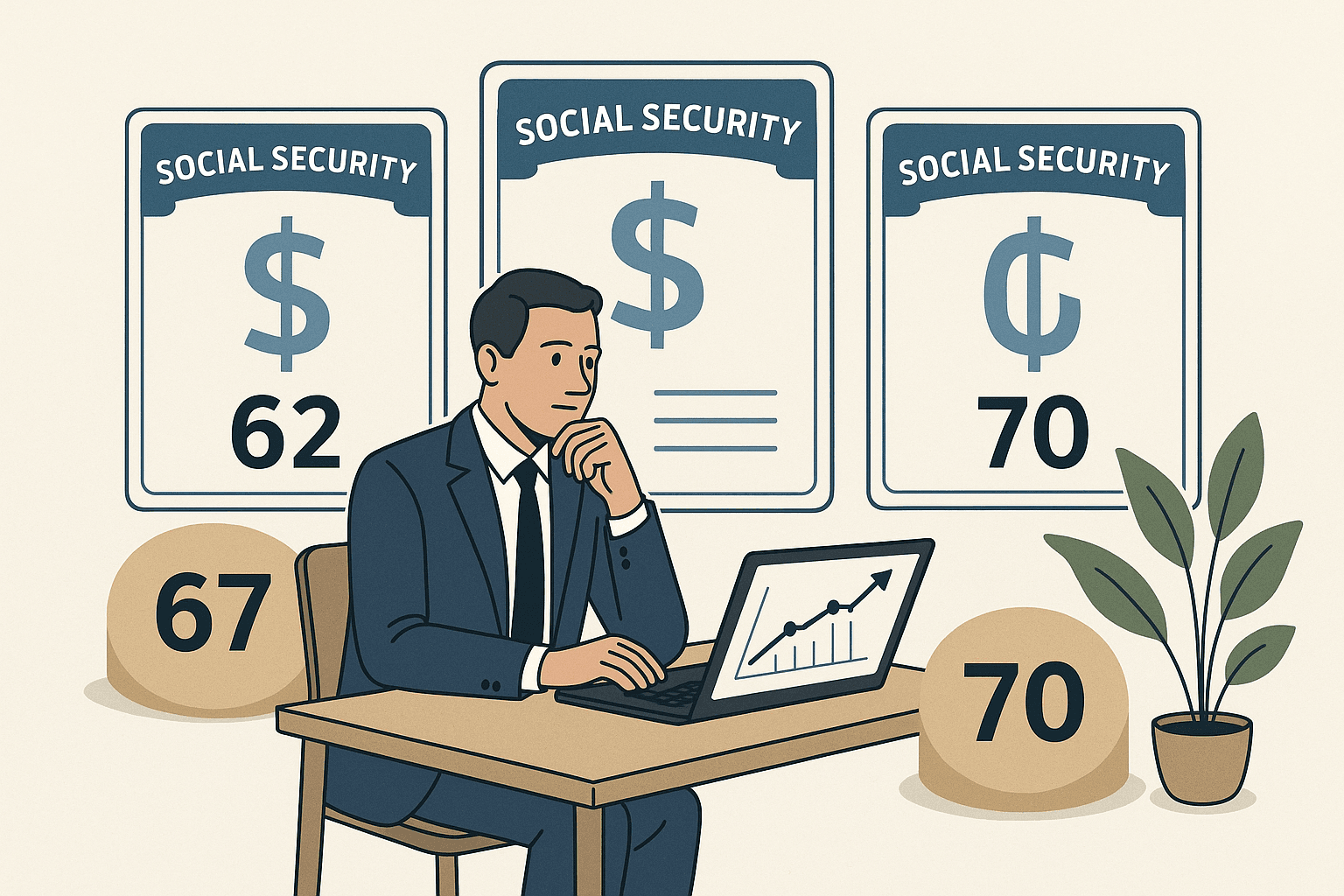
Practical example (FRA = 67, comparing 62 vs. 70):
- Claim at 62: $1,400/month
- Claim at 70: $2,480/month
- Extra per month from waiting: $1,080
- You give up: 96 months of $1,400 = $134,400 in foregone benefits from 62–70
- $134,400 ÷ $1,080/month = 124 months (about 10.3 years) past age 70
- Break-even: approximately age 80.3
After 80, claiming at 70 pays more in total lifetime benefits than claiming at 62.
Quick break-even reference:
| Comparison |
Break-Even Age (Approx.) |
| Age 62 vs. Age 67 |
~78–79 |
| Age 67 vs. Age 70 |
~82–83 |
| Age 62 vs. Age 70 |
~80–81 |
The Spousal Benefit Dimension
Social Security decisions for married couples are more complex than for single individuals.
Key rules:
- A spouse can claim up to 50% of the other spouse's FRA benefit (not their actual benefit if delayed)
- Survivor benefits: a surviving spouse inherits the deceased spouse's actual benefit, including any delayed credits
- The higher-earning spouse delaying to 70 is often the most powerful move for a couple — it maximizes the survivor benefit for the longer-living spouse
Example: If the higher earner's FRA benefit is $3,000 and they delay to 70 ($3,720/month), and the lower earner claims their own $1,200/month at 67 — when the higher earner passes, the surviving spouse's benefit increases from $1,200 to $3,720. This is often worth far more than both spouses claiming early.
Social Security Taxation: What Retirees Miss
Your Social Security benefit may be partially taxable depending on your "combined income":
Combined income = Adjusted gross income + Non-taxable interest + 50% of Social Security benefits
| Filing Status |
Combined Income |
% of SS Benefits Taxable |
| Individual |
Under $25,000 |
0% |
| Individual |
$25,000–$34,000 |
Up to 50% |
| Individual |
Over $34,000 |
Up to 85% |
| Joint |
Under $32,000 |
0% |
| Joint |
$32,000–$44,000 |
Up to 50% |
| Joint |
Over $44,000 |
Up to 85% |
Note: Up to 85% of benefits may be subject to federal income tax — not that 85% of your benefit is taxed, but that up to 85% of the amount is included in taxable income.
Methodology
Benefit reduction and delayed credit percentages from Social Security Administration official publications (SSA Publication 05-10147 and SSA.gov). Break-even calculations use SSA benefit formula and CPI assumptions consistent with historical averages. Tax threshold data from IRS Publication 915. All examples use illustrative benefit amounts — your actual benefit depends on your earnings history. Verify your estimated benefit at ssa.gov/myaccount.
Frequently Asked Questions
When should I claim Social Security if I'm in poor health?
If you have a serious health condition or family history suggesting you won't reach your late 70s, claiming at 62 or 63 typically maximizes total lifetime benefits. The break-even for delaying to 70 is approximately age 80–83.
What is the Social Security break-even age?
The break-even age is when your total lifetime benefits from waiting match what you'd have received by claiming earlier. Comparing age 62 vs. 67 claims, the break-even is roughly 78–79. Comparing 67 vs. 70, it's roughly 82–83.
Can I work while collecting Social Security before Full Retirement Age?
Yes, but your benefits are reduced if you earn above the annual limit ($22,320 in 2026 — verify at ssa.gov). For every $2 earned above the limit, $1 in benefits is withheld. After FRA, you can earn unlimited income with no benefit reduction.
What happens if I claim at 62 and change my mind?
You have one opportunity to withdraw your application within 12 months of your first payment. You must repay all benefits received. After 12 months, you can suspend benefits at FRA to earn delayed credits going forward — but you cannot undo benefits already received.
Is it better to take Social Security early and invest it?
The "claim early and invest" strategy sometimes appears favorable in projections, but it requires generating after-tax investment returns above the 8% annual delayed credit — which is a guaranteed return. In most real-world scenarios with average market returns and taxes on investment gains, delaying beats the invest-early strategy for long-lived retirees.
How does divorce affect Social Security?
If you were married for 10+ years, you may claim a spousal benefit up to 50% of your ex-spouse's FRA benefit — without affecting their benefit or current spouse's benefit. You must be unmarried and at least 62. Your ex does not need to have filed for benefits yet (if divorced for 2+ years).
What is the maximum Social Security benefit in 2026?
The maximum benefit at age 70 in 2026 is approximately $4,873/month (for workers who earned at or above the Social Security wage base for 35 years). Verify current maximums at ssa.gov.
Does Social Security run out?
Social Security's trust fund faces a projected shortfall around 2033 per the 2025 Trustees Report, at which point benefits could be reduced to approximately 79% of scheduled amounts without legislative changes. Most analysts expect Congress to act before cuts occur — but this is a real risk factor for long-range planning.
Written by the SeniorSimple editorial team. All benefit percentages and thresholds sourced from SSA.gov and IRS Publication 915 as of May 2026. Social Security rules and benefit amounts change annually. Verify your personal estimated benefit at ssa.gov/myaccount. This article is for informational purposes only and does not constitute financial advice. Consult a qualified financial planner before making claiming decisions.